That physical growth is the reason Sweekar stands out. Plenty of virtual companions can chat or display animated emotions. Sweekar makes the relationship tangible: the body itself becomes a record of the attention you have invested. I think it is strongest for adults who miss the ritual of a Tamagotchi but want more continuity, customisation, and personality than a tiny screen once offered.
Sweekar in One Minute: Who This Growing AI Pet Is For
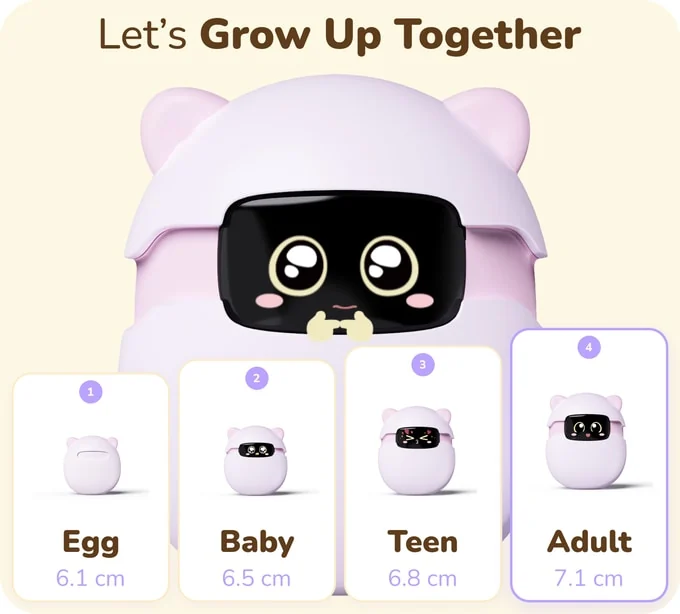
The basic idea is easy to grasp. Sweekar arrives as an egg, hatches, and moves through Baby, Teen, and Adult stages. Everyday care earns experience, while each stage changes how the character looks, sounds, and behaves. Its speech begins with small pre-verbal sounds and is designed to become more capable as the relationship develops.
The best fit is not someone looking for a fully capable voice assistant on day one. It is an adult who enjoys a slow-burn nurturing loop and wants a small character to check in with across the day. A collector may enjoy the outfits, shells, and printable accessories. Someone unable to keep a living animal may appreciate a companion ritual without treating the device as a substitute for a real pet.
The product is reported as intended for users aged 18 and over, despite its toy-like appearance. That matters because its connected AI, account features, and memory deserve adult judgment rather than being treated as a children’s gadget.
The Clever Part Is Not the Chatbot. It Is the Body
Most digital pets represent growth with a new sprite, a level number, or a fresh menu. Sweekar uses a stepper-driven mechanism to increase the height of the physical device. Its four stated sizes are 6.1 cm as an egg, 6.5 cm as a baby, 6.8 cm as a teen, and 7.1 cm as an adult.
A centimetre of total growth may sound modest, but scale is not the point. The shell opening and the body becoming taller give the owner a physical milestone. You can glance at it on a desk and see that the relationship has moved forward. That is much more specific than attaching an animated face to a generic chatbot.
Care Becomes Something You Can See and Feel
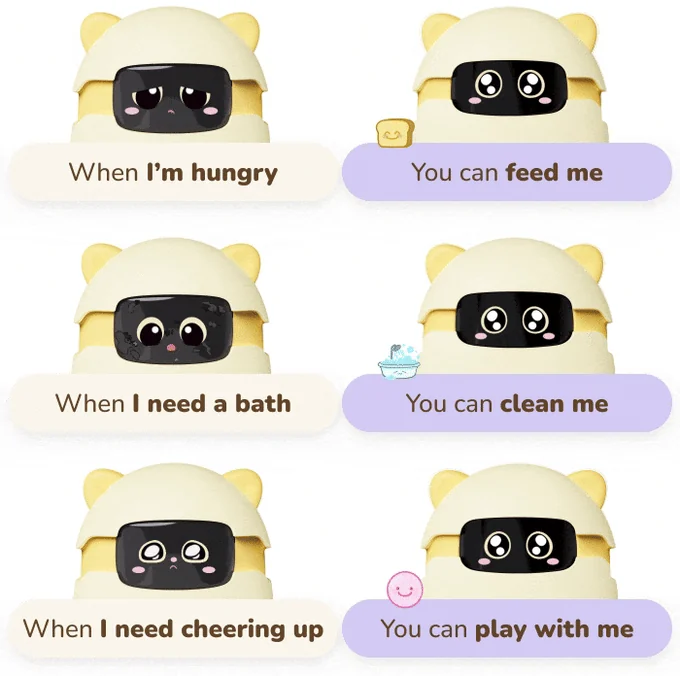
Feeding, bathing, playing, talking, and picking Sweekar up contribute to its care loop. The character has status indicators such as hunger, energy, cleanliness, and fun, visible through the companion app. Touch and motion sensing are intended to make the device react when it is handled, while its screen supplies the expressive face.
Imagine an office worker keeping Sweekar beside a keyboard. A quick check during a break is not just clearing a notification. It feeds a longer arc that will eventually alter the object on the desk. Or picture a collector returning after a busy day and seeing a different response because the pet has tracked the gap between interactions. Those small moments are where the physical design can make routine care feel consequential.
There is a deliberate trade-off here. A device built around gradual development asks for patience. Anyone who wants instant access to every conversation feature may find the early stages restrictive. For someone who enjoys anticipation, however, withholding capabilities gives the milestones more meaning.
Learning to Speak Is Part of the Relationship
Sweekar is not presented as fully conversational from the moment it hatches. Early vocalisations are intentionally limited to baby-like sounds. Words and clearer conversation emerge later, making speech itself part of the reward structure.
What interests me is the reversal of the usual AI product pitch. Most assistants try to demonstrate competence immediately. Sweekar asks the owner to accept ambiguity first, then treats clearer language as evidence of growth. If the timing, voice design, and responses feel coherent, that could create a stronger sense of attachment than a character that knows everything from the first minute.
The difficult part will be sustaining the illusion. Early sounds need enough variety to remain charming, and later dialogue needs to feel connected to what came before. Takway says its long-term emotional memory can retain preferences, moods, and past conversations, but that kind of continuity needs months of real-world use before it can be considered proven.
Memory and Personality Create Continuity
Sweekar begins as a blank slate. Care and interaction are designed to move four personality dimensions until the app reveals an MBTI-style type. The concept is less about psychological accuracy than giving different owners a visible record of how their raising style shaped the character.
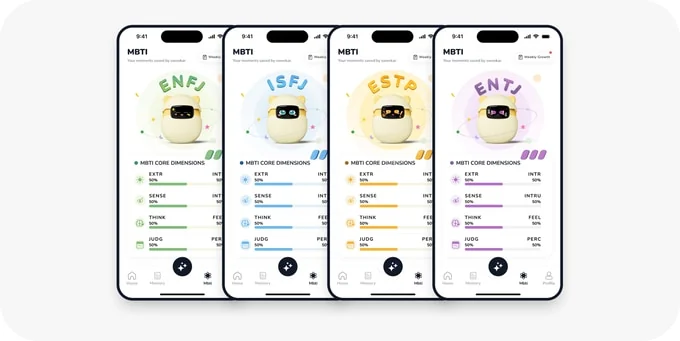
Memory supports the same idea. The brand gives examples such as remembering a nickname, a favourite drink, or a frequently played song. These are company-described capabilities rather than independent long-term test results, so I would view them as the intended experience, not a guarantee that every recollection will be accurate or appropriately timed.
A Pocket Pet Designed to Leave the Desk
At about 89 g (3.1 oz), Sweekar is small enough to carry in a pocket or bag. It can connect through 2.4 GHz Wi-Fi or a phone hotspot, and basic care is meant to continue when there is no signal. Advanced conversation, cloud memory, generated content, and updates naturally depend more heavily on connectivity.
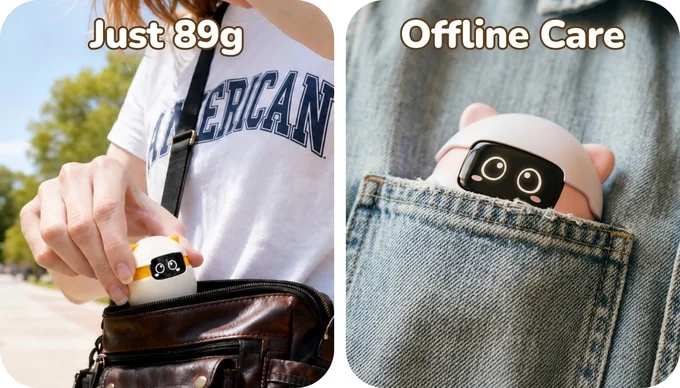
That split is sensible. On a commute, a user should be able to check simple needs without hunting for a network. At a hotel or café, a phone hotspot can restore richer features. The distinction also prevents the phrase “works offline” from becoming misleading: the basic pet loop can remain available, but the full AI experience is still connected.
Battery expectations belong in the same practical picture. Published coverage cites up to two hours of active interaction and up to eight hours when inactive, with USB-C charging and a base that allows interaction while charging. Those figures come from product claims, not an independent battery test. Heavy conversational use could therefore keep the device near its base more often than the pocket-pet image suggests.
Adulthood Opens a Wider Play Loop
Reaching adulthood is meant to expand the routine rather than end it. Adult Sweekar can take virtual trips lasting a few hours and return with generated photos, postcards, or souvenirs recorded in the app. The feature gives the character something to do between direct care sessions and turns absence into a source of stories.
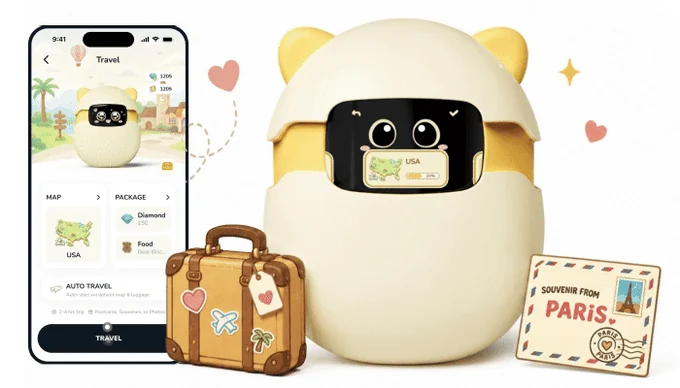
There are social and creative extensions too. Tapping two Sweekar devices together can form an NFC friendship that the app tracks. Owners can change outfits and shells, use the product box as a small home, or download open-source 3D models to print accessories. Those choices matter because a long-lived companion needs more than conversation to remain interesting.
I would not buy Sweekar solely for generated travel postcards. The stronger idea is how these systems reinforce one another: care unlocks adulthood, adulthood opens new activities, and those activities add memories and objects to the shared history. The loop has a clearer shape than an endless chat window.
Privacy Is the Question Sweekar Has to Answer Clearly
Sweekar is described as having no camera, which directly addresses a misconception visible in some online reactions. A handful of virtual-pet enthusiasts objected to what they thought was a built-in video or camera memory system. Their broader discomfort with an always-nearby AI companion is still relevant, but the camera assumption should not be repeated as fact.
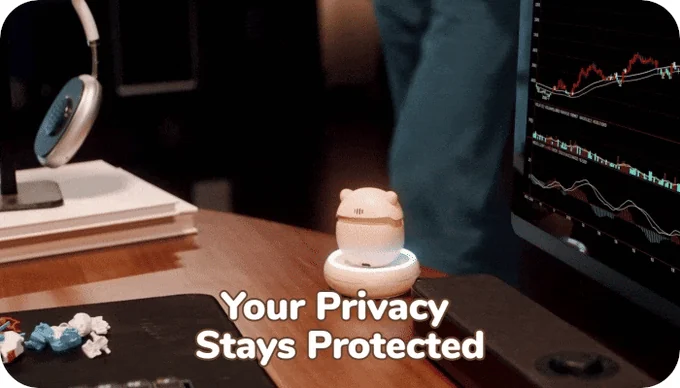
No camera does not settle every privacy question. Sweekar uses microphones, connected accounts, and cloud-assisted functions. Before committing personal stories to any companion device, I would want clear answers about what is uploaded, how long memories are retained, whether individual entries can be deleted, how an account can be erased, and what happens if the online service changes or closes.
The brand promotes privacy safeguards, but detailed retention and deletion controls are more useful than a broad promise. This is not a reason to dismiss the product. It is a fit condition: Sweekar makes the most sense for someone comfortable with cloud-connected AI and willing to review the final policies and app permissions carefully.
Is Sweekar Worth Backing?
I think Sweekar earns attention because it has a product-specific answer to a crowded question. Instead of asking why an AI companion needs another cute shell, it uses the shell as part of the relationship. Physical growth, delayed speech, evolving traits, and adult-stage autonomy all express the same idea: attention should leave a visible history.
I would consider Sweekar for an adult who enjoys nurturing routines, character collectibles, and small daily rituals. It also suits someone fascinated by embodied AI but uninterested in a full-size desktop robot. The strongest buyer will enjoy the journey from limited baby sounds to a more capable adult, rather than judging value only by what the device can do immediately.
It is a weaker fit for anyone opposed to cloud-assisted memory, unwilling to manage another charged device, or frustrated by deliberately gated abilities. Crowdfunding also carries the usual execution risk, especially when a compact product combines moving hardware, sensing, voice interaction, an app, and online services.
If the physical-growth concept is the part that keeps pulling you back, visit the Sweekar campaign and review the current details. I would focus on the final privacy terms, included conversation allowance, connectivity requirements, and support commitments before choosing a pledge.
Disclosure: This article contains an affiliate link. We may earn a commission at no extra cost to you.
Sweekar FAQ
Does Sweekar really grow physically?
Sweekar is designed to expand through four physical stages using an internal stepper-driven mechanism. Its stated height increases from 6.1 cm (2.4 in) as an egg to 7.1 cm (2.8 in) as an adult.
Does Sweekar work without an internet connection?
Basic care is intended to work offline. Richer AI conversation, cloud memory, generated content, software updates, and other connected features require Wi-Fi or a phone hotspot.
Does Sweekar have a camera?
No. The published product description says Sweekar does not include a camera. It does use microphones and connected services for voice and AI features.
How does Sweekar develop its personality and voice?
Care and interaction earn experience and influence four personality dimensions shown in the app. Its voice is staged as well, beginning with pre-verbal sounds and becoming clearer and more conversational as it matures.
Who is Sweekar designed for?
Sweekar is reported as intended for adults aged 18 and over. It is best suited to people who enjoy virtual-pet care loops, character customisation, and a gradual relationship with a connected AI companion.