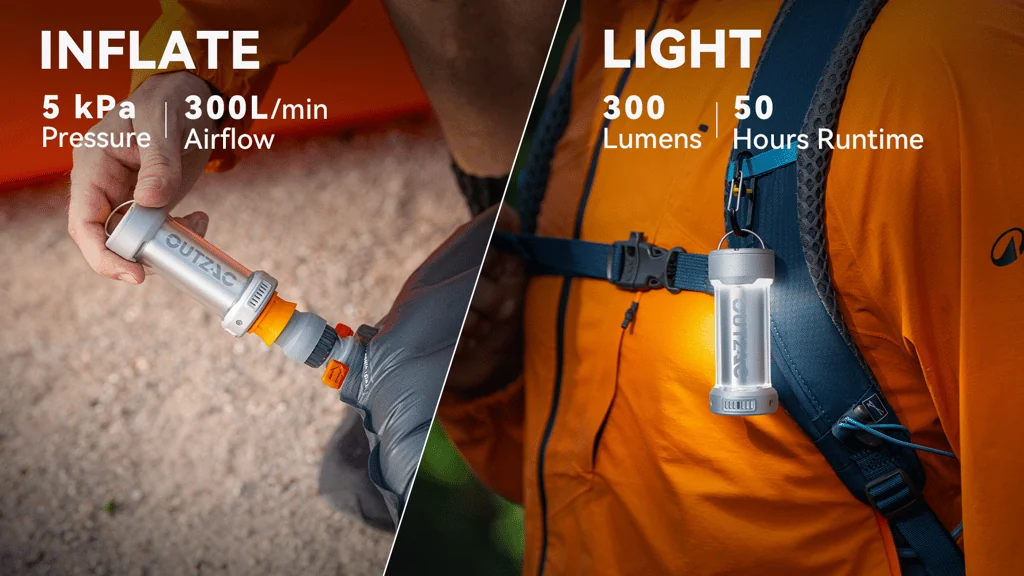
Beam Pump combines two pieces of camping gear that many backpackers already carry: an electric inflator for a sleeping pad and a hanging tent light. The complete device weighs a claimed 78 g (2.7 oz), measures roughly 38 × 90 mm, moves air in both directions, and provides four lighting levels up to 300 lumens.
I think the strongest case for Beam Pump is not that it has a long feature list. It is that both halves address real moments at camp. The pump takes the breath and effort out of setting up a pad, while the lantern keeps a headlamp from becoming the only source of shared light. If you already pack both items, combining them is a credible way to simplify a lightweight kit.
Beam Pump’s Real Idea Is Weight Consolidation
Small electric pumps are no longer unusual, and neither are rechargeable camp lights. Beam Pump becomes interesting because OUTZAC has designed those functions as one object rather than attaching a novelty light to a pump.
The campaign compares the 78 g Beam Pump with a separate camp light and air pump weighing 126 g together. That is the brand’s comparison, so the actual saving depends on the gear you use now. One outdoor creator who received a review unit made a more useful qualitative point: the Beam Pump was lighter than either the pump or lantern previously carried, not just lighter than the pair.
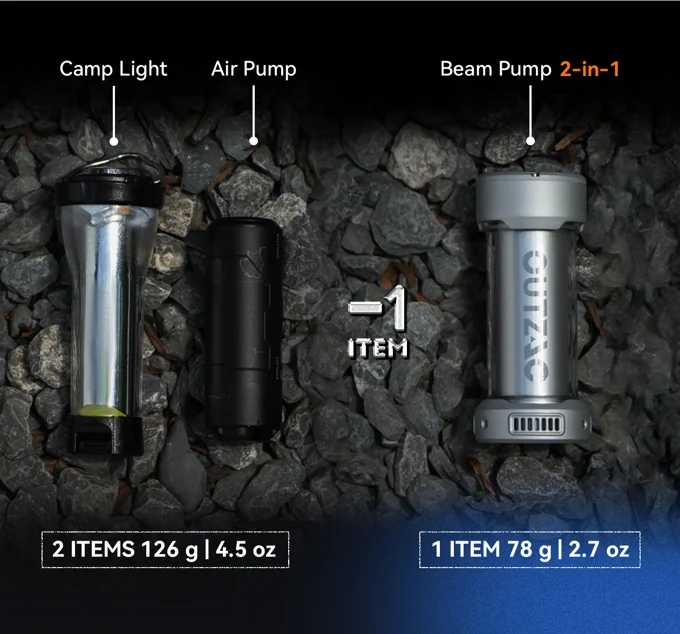
That distinction matters. A two-in-one product only earns space in a backpack if both jobs are good enough to replace the originals. Someone who inflates by mouth and uses only a headlamp would be adding weight, not saving it. Someone who already enjoys an electric inflator and a diffused tent light has a much clearer reason to consider the swap.
The cylindrical body is around 38 mm wide and 90 mm tall. A second video describes it as approximately 38.5 mm wide, which is close enough to treat as rounding rather than a meaningful disagreement. There are separate controls for the light and pump, a charging port, and a small loop that lets the lamp hang from a tent or pack.
Six Nozzles and Two Airflow Directions
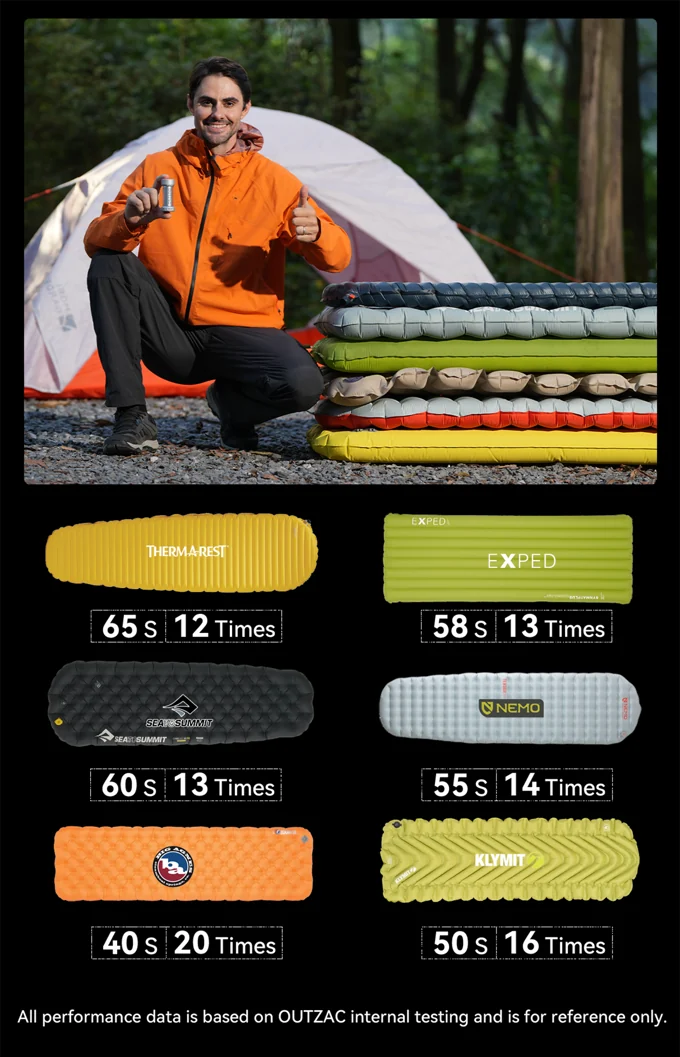
Beam Pump comes with six push-fit nozzles intended for several valve sizes and inflatable categories. The campaign specifically references pads from Therm-a-Rest, Sea to Summit, Exped, Big Agnes, Klymit, and Nemo, although those names indicate compatibility rather than affiliation or endorsement.
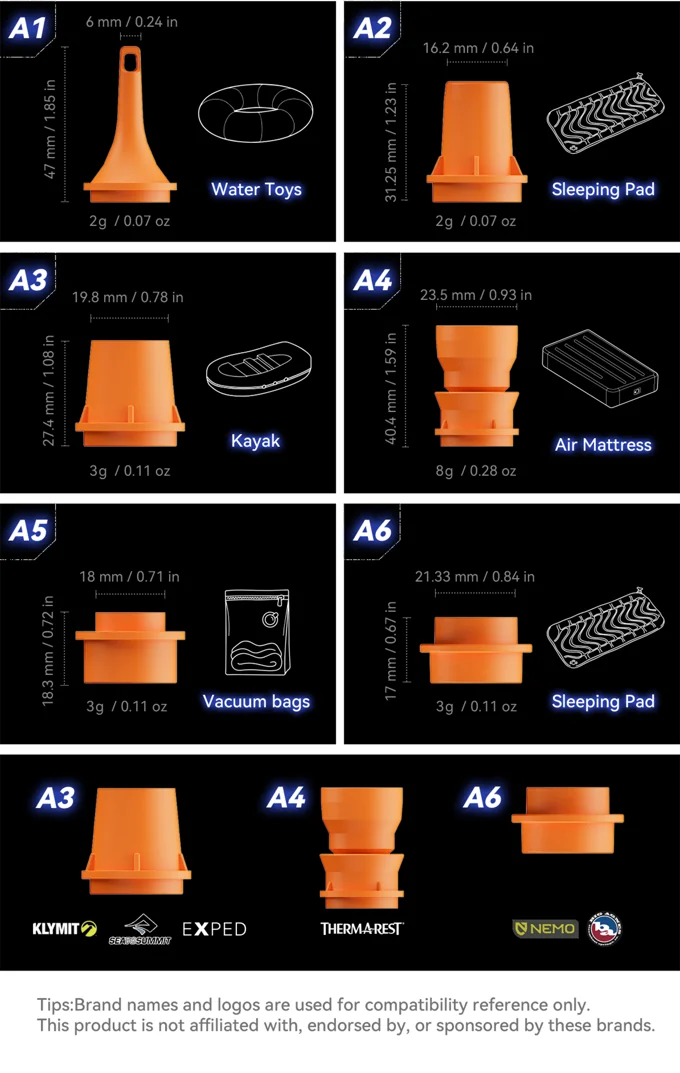
The adapter set is important because compact pumps live or die by the seal at the valve. The motor can move plenty of air, but a loose adapter wastes flow and makes hands-free inflation less convincing. I would check the shape and diameter of my pad valve against the campaign’s nozzle chart before choosing a reward.
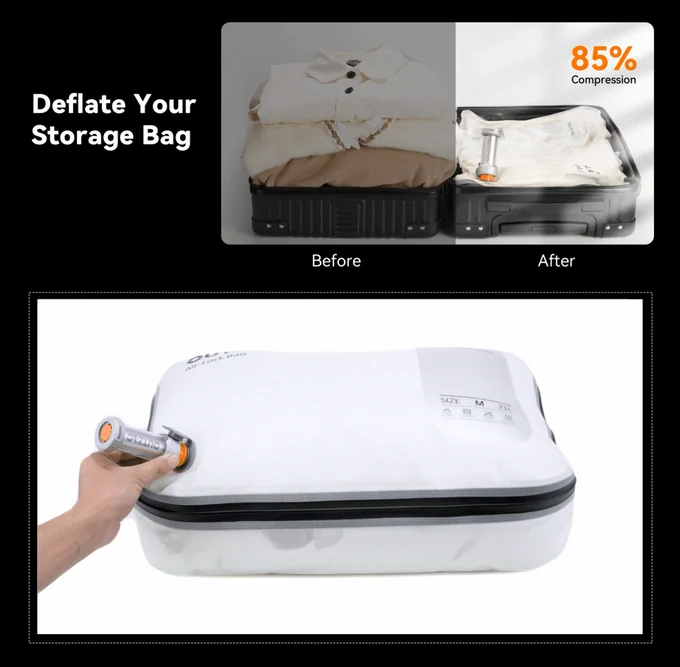
Air exits one port for inflation and enters the other for deflation. That makes the device useful after the night as well as before it: it can remove lingering air from a pad or compatible storage bag, helping the item fold or roll more neatly. It is a simple mechanical choice, but it broadens the value of carrying the motor.
Pad Inflation Is the Core Job
OUTZAC rates the pump at 300 L/min airflow and 5 kPa maximum pressure. Those numbers point to a high-volume, low-pressure tool. Sleeping pads, inflatable pillows, air mattresses, water toys, and similar gear are the natural targets.
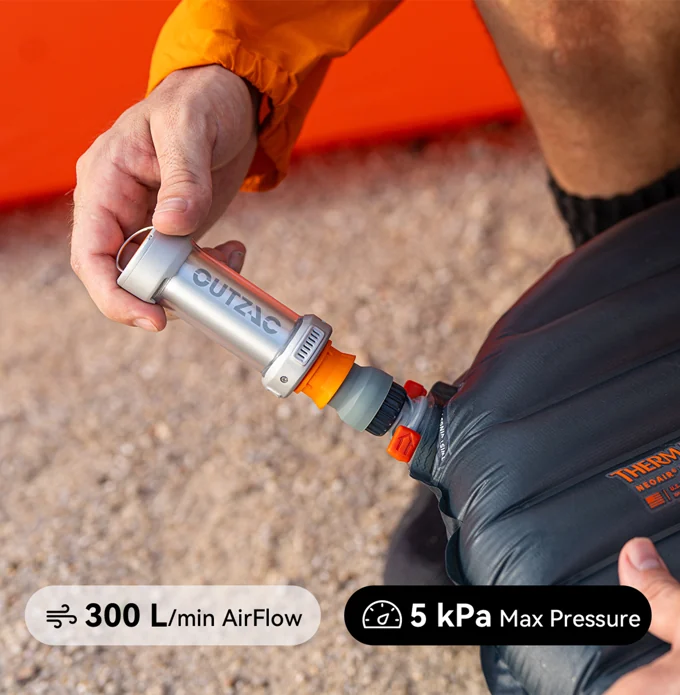
The campaign advertises hands-free sleeping-pad inflation in roughly 40 to 65 seconds, depending on the pad. Its internal test graphic shows different times and numbers of inflations per charge across six pad models, so a single universal figure would be misleading. Pad volume, valve design, remaining battery, temperature, and the quality of the nozzle seal can all affect the result.
Two videos add practical context. In one, a creator connects the pump to an air mat and shows it inflating in real time. In another, the presenter inflates a pillow and a larger partially self-inflating mat, then uses the reverse port to remove air. These demonstrations are useful, but they are not controlled tests: one product was supplied for review, another appears to be a prototype, and both transcripts were generated by speech recognition.
The Double-Press Control Solves a Small Trail Annoyance
One detail I particularly like is the double-press activation for the pump. The creator of the longer field video contrasted it with a personal pump that could switch on inside a backpack after a single accidental press. Requiring two presses does not change inflation performance, but it addresses a believable trail problem: an unnoticed motor can waste charge and announce itself from inside a packed bag.
Where the Pressure Stops Being Enough
Five kilopascals is appropriate for moving a large volume of air into soft camping gear, not for finishing high-pressure equipment. New Atlas notes that Beam Pump may help give a stand-up paddleboard its initial shape, but a dedicated high-pressure pump would still be needed to complete the job. I would treat SUP use as a possible head start, not a reason to leave the proper pump at home.
Noise also deserves realistic expectations. The reported figure is 65 dB. That is quieter than some tiny pumps and one creator considered it quieter than a personally owned model, but it will still be obvious in a calm campsite. Beam Pump is compact, not silent.
The Lantern Is More Than a Token Add-On
The lantern has four brightness settings: 6, 60, 160, and 300 lumens. That spread gives the light a practical progression. Six lumens can provide soft orientation light in a tent, the middle settings suit gear organization or conversation, and the maximum can illuminate a larger area for short tasks.
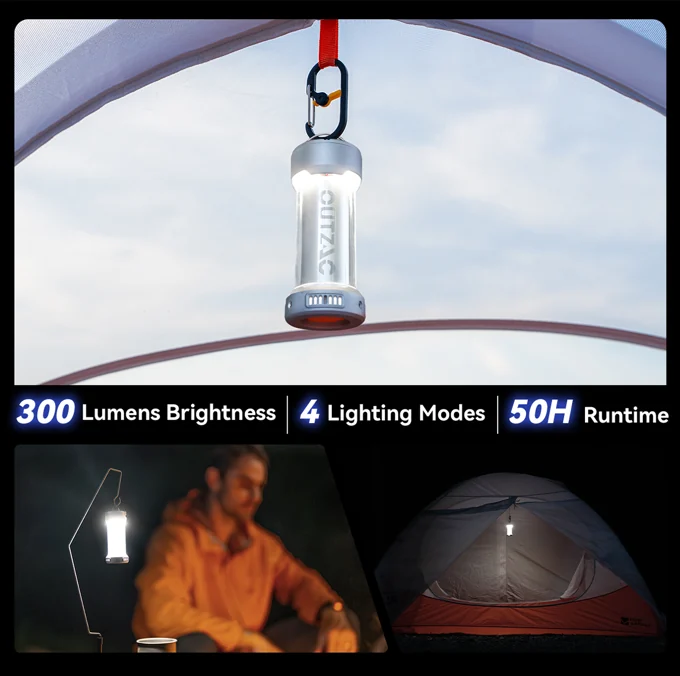
OUTZAC claims up to 50 hours of runtime at the lowest setting. That figure should not be read as 50 hours at 300 lumens, and real runtime will vary with brightness, temperature, battery age, and any pump use from the same cell. The shared battery is part of the device’s efficiency, but it also means inflation and lighting draw from one energy budget.
The design reportedly moved from a cooler 4200 K light to a warmer 3800 K after creator feedback. That sounds like a sensible decision for a lantern meant to live inside a tent. Warm diffused light is usually more comfortable around camp than the narrow, high-contrast beam of a headlamp.
Three Camp Moments Where the Combination Makes Sense
The first and clearest scenario is the end of a long hiking day. A solo backpacker reaches camp, connects the right nozzle, double-presses the pump, and can unpack or organize other gear while the sleeping pad fills. The benefit is not merely speed; it is removing another small task when energy and daylight may be limited.
The second appears the next morning. Air that remains trapped in a pad makes it harder to roll tightly. Moving the nozzle to the intake side lets Beam Pump pull air out rather than relying only on body weight and repeated folding.
The third is the transition from setup to downtime. Once inflation is finished, the same object can hang from a tent loop. A low mode gives enough shared ambient light to find clothing or talk without wearing headlamps, while brighter modes are available for sorting gear. This is where the two-in-one design feels coherent: the pump’s main job ends just as the lantern’s job begins.
Who Should Consider Beam Pump?
I would put weight-conscious backpackers who already carry an electric pad pump and a lantern at the top of the list. They are most likely to gain a real reduction in objects and possibly weight. It also makes sense for solo campers who value hands-free setup, couples sharing one tent light, and travellers who can use reverse airflow with compatible storage bags.
Fit matters more than the headline specifications. The nozzles need to match your actual valves. The rechargeable battery is reported as non-replaceable, so users planning long trips will need a charging strategy and should consider long-term battery serviceability. The stated IPX4 protection covers splashes rather than immersion or sustained exposure to rain. OUTZAC also lists a minimum operating temperature of -10 °C (14 °F), but that and the water-resistance rating remain manufacturer claims rather than independently verified field results.
I would not choose Beam Pump as the only inflator for high-pressure boards, tyres, or equipment that needs a precise pressure finish. Nor is it an automatic weight-saving purchase for someone perfectly content to inflate a pad manually. Its strongest value comes from replacing two items you genuinely planned to carry.
Beam Pump FAQ
Can Beam Pump inflate and deflate a sleeping pad?
Yes. It uses separate airflow sides for blowing and suction, with adapters intended for several common sleeping-pad valves. Compatibility should be checked against the valve on your specific pad.
How fast does Beam Pump inflate a pad?
OUTZAC advertises approximately 40 to 65 seconds for tested sleeping pads. The exact time depends on pad volume, valve design, nozzle seal, battery state, and conditions, so it is best understood as a claimed range.
Can it fully inflate a stand-up paddleboard?
It may move the initial volume of air, but its 5 kPa maximum pressure is not intended to finish a high-pressure SUP. A suitable dedicated pump is still required.
How bright is the lantern?
The four listed settings are 6, 60, 160, and 300 lumens. OUTZAC claims up to 50 hours at the lowest setting, not at maximum brightness.
Is Beam Pump waterproof?
The reported rating is IPX4, which means protection against splashing water. It should not be treated as submersible or left exposed to sustained rain.
Is it quiet enough for a campsite?
The reported noise level is 65 dB. One reviewer found it quieter than another compact pump, but it remains an audible electric motor.
The Bottom Line
Beam Pump has a more convincing design logic than many combination gadgets. Inflation and tent lighting happen at adjacent moments, both functions suit the same compact cylindrical body, and a shared battery can remove duplicated hardware. At a claimed 78 g, the package is especially relevant to backpackers who already allocate weight to both jobs.
The decision comes down to your kit. If the six adapters match your sleeping pad and you want a rechargeable lantern as well as hands-free inflation, I think Beam Pump is worth a close look. If you need high pressure, replaceable batteries, or only one of its two main functions, the consolidation argument becomes weaker.
Check the Beam Pump campaign and current reward details.
Disclosure: This article contains an affiliate link. We may earn a commission at no extra cost to you.