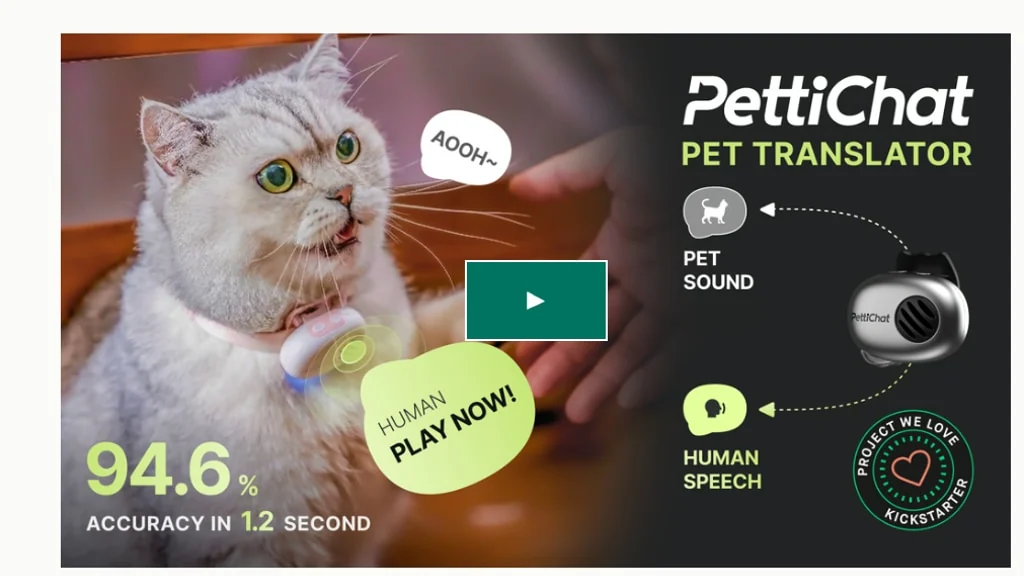
PettiChat is an AI collar and companion app designed to turn a cat or dog’s sounds and behaviour into short human-readable messages. It also works in the other direction, converting an owner’s words into sounds intended for the pet. That two-way loop is what separates PettiChat from a simple bark detector or activity tracker.
I think the most useful way to judge it is as a contextual interpreter, not a machine that has cracked a secret animal vocabulary. For curious pet owners who already pay attention to posture, routines, and surroundings, PettiChat could add a timely prompt and a record of recurring signals. Anyone expecting scientifically established, word-for-word animal speech should set a much higher bar.
PettiChat at a Glance
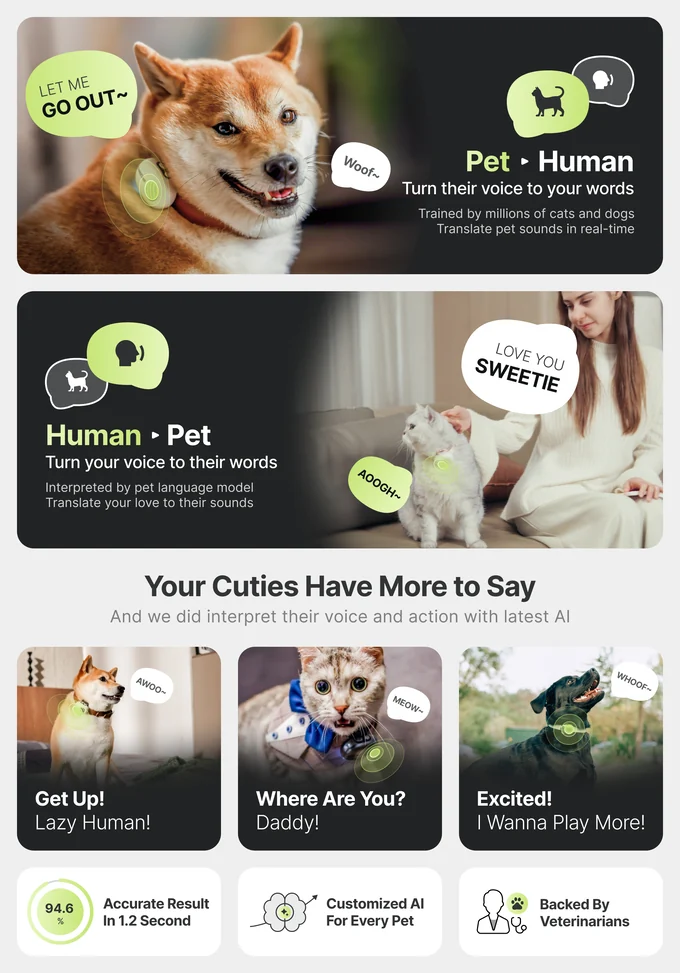
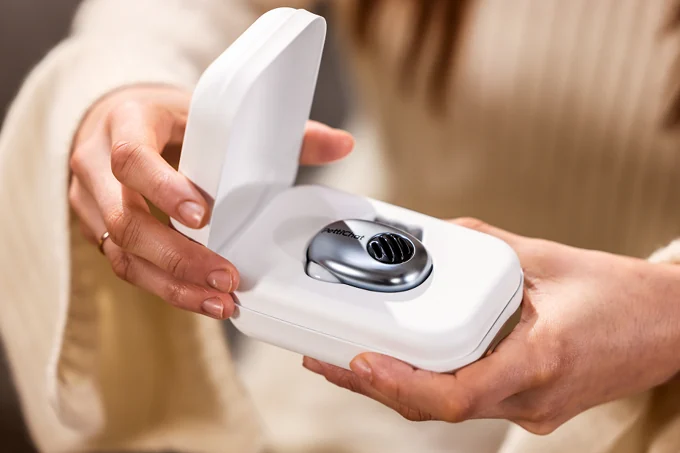
PettiChat combines a collar-mounted device with software that displays its interpretations. In pet-to-human mode, the system is presented as analysing vocal and behavioural information before producing a phrase or emotional label. In human-to-pet mode, an owner speaks through the software and the hardware plays a sound intended to communicate the message back.
The brand says its Pet-LLM was trained on more than 1.5 million real-world samples, reaches 94.6% contextual accuracy, and returns a result in about 1.2 seconds. Those are precise performance claims, but they should be treated as the company’s own measurements until the test method and independent replication are clear.
The broader product concept is easier to understand. A meow, bark, or whine rarely exists in isolation. Movement, timing, repeated routines, and the situation around the animal all affect what the signal may mean. PettiChat’s proposed advantage is that it tries to combine these clues rather than assign a fixed phrase to sound alone.
What interests me is the complete loop:
- pet sounds and behaviour become an app-based interpretation;
- an owner’s spoken message becomes a pet-directed sound;
- conversation history preserves earlier events for comparison;
- location tracking adds a practical function beyond translation.
That mix makes PettiChat more interesting than a novelty voice generator, although its value still depends on how reliably the interpretations reflect each individual animal.
How the Two-Way Translation Loop Is Supposed to Work
From Meows, Barks, and Movement to an App Phrase
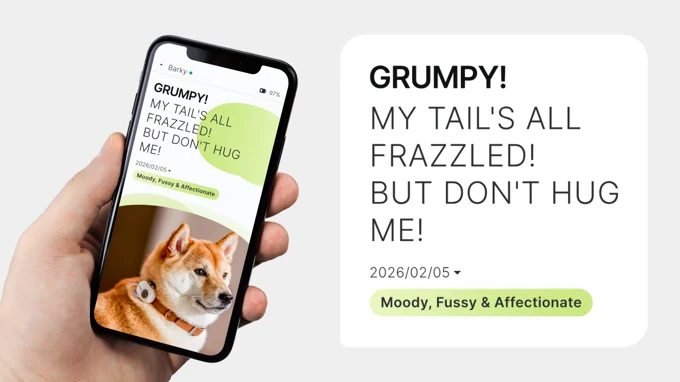
The pet-to-human side begins with the collar detecting a vocal event. PettiChat is presented as considering both sound and behaviour, with promotional descriptions pointing to vocal patterns, movement, and posture as inputs to its AI model. The result then appears in the companion software as a short phrase or emotional state.
This design choice matters. A single cat sound might occur before feeding, during play, beside a closed door, or when the animal wants space. A system that can compare sound with movement and context has a better conceptual foundation than one that treats every similar meow as the same “word.”
The output is still an interpretation. If PettiChat displays a phrase suggesting play or irritation, the owner has to compare that prompt with the pet’s ears, tail, body position, environment, and recent routine. The phrase can direct attention, but it should not override the animal in front of you.
I would approach the app as a hypothesis generator. Its best result may be prompting an owner to notice a repeated pattern sooner, not delivering a perfect sentence that can be accepted without question.
From an Owner’s Voice Back to a Pet-Directed Sound
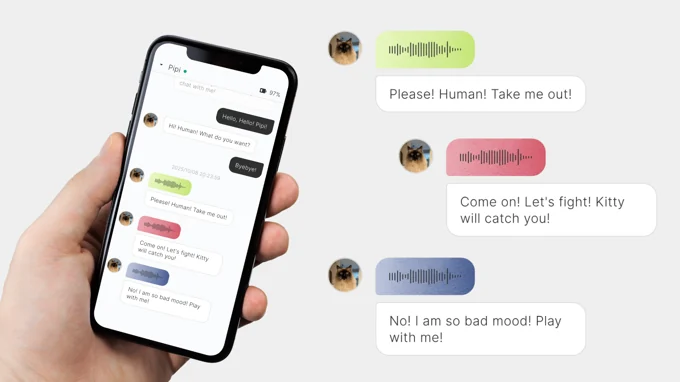
The reverse direction is PettiChat’s more unusual feature. A demonstration shows an owner pressing a control, speaking a message, and playing a generated sound through the device. The same demonstration then switches back to pet-to-human interpretation.
That creates a more engaging experience than passive monitoring. An owner can respond within the same system instead of only reading labels. It is also the part that needs the most careful expectation setting. Producing a pet-oriented sound is not the same as proving that a cat or dog understood a particular human sentence.
Animals can learn associations between sounds, actions, objects, and routines, but that does not automatically make a generated sound a direct translation. I would look for consistent behavioural responses over time and keep normal cues such as tone, gesture, and repetition in the interaction. Used that way, the two-way function could become a structured communication ritual without pretending the collar has created a shared dictionary.
“Translation” Is the Promise and the Hardest Claim
What 94.6% Contextual Accuracy Needs to Mean
PettiChat’s 94.6% contextual-accuracy figure sounds reassuring, yet an accuracy percentage is only useful when the underlying task is defined. Was the system identifying broad emotional categories, selecting among several labelled intentions, or matching a specific phrase? Who established the correct answer, and how were ambiguous signals handled? Did the test include animals whose data had not already influenced the model?
Those questions are especially important because the campaign connects its Pet-LLM with peer-reviewed research, while critical video coverage argues that the advertised performance lacks independent product-level verification. The two positions are not automatically compatible. Research can inspire a model without validating the accuracy of a particular commercial device.
This does not make the product concept worthless. It means the percentage should stay attached to the brand’s claim rather than becoming a promise about every pet, setting, and vocalisation. A transparent validation protocol would do more for PettiChat’s credibility than another polished example of a collar producing a plausible sentence.
Why Context Can Still Be Useful Without Literal Sentences
Pet communication is richer than audio. Ear position, tail movement, eye contact, distance, smell, social dynamics, and the immediate environment can all change the meaning of a vocalisation. That makes literal translation an extremely demanding goal, but it also explains why contextual classification can still be useful.
Imagine a dog barking energetically while moving towards a toy. A play-related prompt would be plausible because several signals point in the same direction. The same bark near a window, with a stiff posture and attention fixed outside, may mean something different. PettiChat becomes more credible when its phrase is understood as a compact summary of probabilities rather than access to the dog’s exact thoughts.
That distinction is central to my view of the product. If the app helps an owner pause, inspect the context, and respond more thoughtfully, it can add value even when the wording is imperfect. If it encourages the owner to ignore obvious body language because a screen produced a cute phrase, it has failed at the more important job.
The Practical Value May Extend Beyond the Translated Phrase
A Record of Behaviour and Vocal Events
The companion app includes chat history, allowing earlier interpretations to be revisited. This could be one of PettiChat’s quieter strengths. A single message may be uncertain, but a pattern of similar sounds and movements around the same routine can be more informative.
For example, a new cat owner might notice that one recurring vocal pattern appears near the food area while another happens before play. The useful outcome is not that PettiChat has assigned permanent vocabulary to each sound. It is that the app can help organise observations that might otherwise be forgotten.
The history should remain an aid to attention, not a diagnostic record. Changes in activity, vocalisation, appetite, or behaviour can have many causes. A generated emotional label should never replace professional advice when an animal appears distressed, unwell, or in pain.
Location Tracking as a Second Reason to Wear the Device
PettiChat also includes location tracking. This gives the collar a practical role when no translation is taking place and may broaden its appeal to owners who worry about an outdoor or escape-prone pet.
I like this combination because it does not force the product’s entire value to rest on sentence-like output. An owner may enjoy the communication layer while relying more consistently on the location function and event history. Before backing, however, I would check the live campaign for the current tracking coverage, connectivity requirements, app compatibility, and battery expectations, since those details determine how useful the feature will be in a particular region and routine.
Where PettiChat Fits Into Everyday Pet Care
The strongest use cases are moments when the collar encourages closer observation.
For a new cat owner, the app could provide a starting point for learning repeated signals. If a phrase appears during a meow near the feeding area, the owner can compare it with timing, posture, and what happens next. Over several days, the history may reveal whether the interpretation is consistent or simply plausible-sounding.
PettiChat may also help during moments when a pet wants space. In one demonstration, the system assigns an angry interpretation while a cat appears unhappy with something nearby. The right response is not to debate the exact wording. It is to notice agitation, create distance, and watch whether the animal relaxes.
For an owner of a dog that bolts through an open gate or follows an interesting scent, location tracking may be the more concrete benefit. The translation layer can remain an engaging extra while the tracking feature supports a familiar safety concern.
These scenarios all rely on an attentive person. PettiChat does not remove the need to learn species-appropriate body language, build predictable routines, or seek help from a veterinarian or qualified behaviour professional. Its best role is to organise and interpret clues, then bring the owner’s attention back to the pet.
Who Should Consider Backing PettiChat?
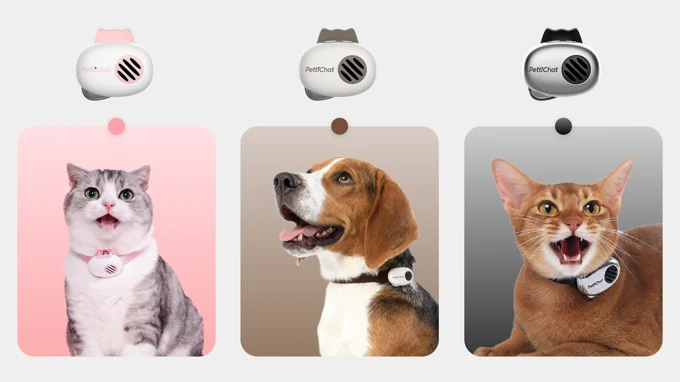
PettiChat is best suited to cat and dog owners who are curious about behavioural patterns and comfortable with probabilistic AI output. It also has a natural audience among early adopters who enjoy experimental pet technology and would value translation, history, and tracking in one system.
I would consider backing it if I wanted the two-way interaction as an engaging layer and was willing to judge its messages against real-world context. The product is particularly appealing when the location and history functions are useful even if the translations prove less precise than the marketing suggests.
It is a weaker fit for anyone who wants scientifically established, word-for-word access to an animal’s thoughts. It may also disappoint owners who prefer not to add another connected device, app, or charging routine to daily pet care.
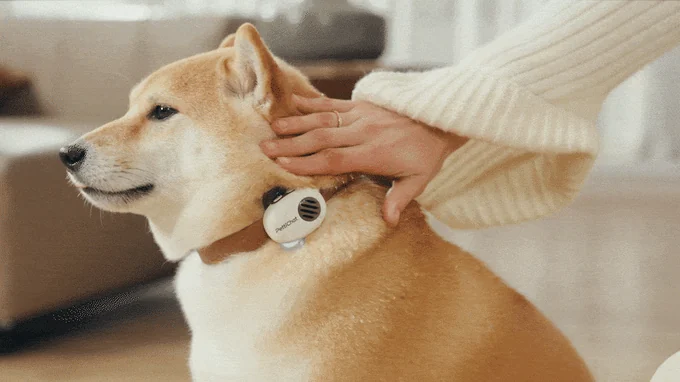
Comfort matters too. Promotional descriptions put the device at 27 g, but fit depends on the animal’s size, collar tolerance, activity, and the hardware’s shape. Owners of very small or collar-sensitive pets should examine the dimensions and wearing guidance on the campaign before deciding.
Is PettiChat Worth Backing?
PettiChat has a compelling idea at its centre: use sound and behaviour to generate a contextual prompt, then let the owner respond through the same collar. The app history and location function make the concept more rounded than a one-trick translator.
My recommendation is conditional. PettiChat is worth considering for an observant owner who sees AI output as another clue and likes the broader collar-and-app package. It is harder to recommend to someone whose decision depends on the 94.6% figure being independently proven or on the device delivering literal conversations.
Crowdfunding also brings normal execution risks around hardware, software, fulfilment, and continued service. The sensible decision is to examine the current campaign details, confirm that the tracking and app requirements suit your location, and decide whether the contextual-interpreter version of PettiChat is valuable enough for you.
If that description fits how you relate to your cat or dog, visit the PettiChat campaign to review the current specifications and backing options.
Disclosure: This article contains an affiliate link. We may earn a commission at no extra cost to you.
PettiChat FAQ
What does PettiChat do?
PettiChat is presented as a two-way AI pet translator. Its collar and app interpret pet sounds and behaviour as short human-readable messages, while the reverse mode converts an owner’s words into pet-directed sounds. It also includes conversation history and location tracking.
Does PettiChat translate a pet’s exact words?
That should not be assumed. The more defensible interpretation is that PettiChat estimates emotional or contextual states from patterns in sound and behaviour. Its output is best treated as a prompt to check against the animal’s body language and surroundings.
Is PettiChat designed for both cats and dogs?
Yes. The product is presented for cats and dogs, and its demonstrations include both species. Individual comfort and fit will still depend on the pet.
What information does the AI appear to analyse?
PettiChat is presented as using vocal and behavioural information rather than sound alone. Promotional explanations discuss patterns such as tone, movement, posture, and activity, although the exact hardware and model implementation should be confirmed in the current campaign specifications.
Does PettiChat include pet tracking?
Location tracking is part of the advertised product. Owners should check the live campaign for current details about coverage, connectivity, battery use, and regional compatibility.
Can PettiChat replace a veterinarian or behaviour professional?
No. A translated phrase or emotional label cannot diagnose illness, pain, anxiety, or a behavioural condition. Concerning or persistent changes should be assessed by an appropriate professional.