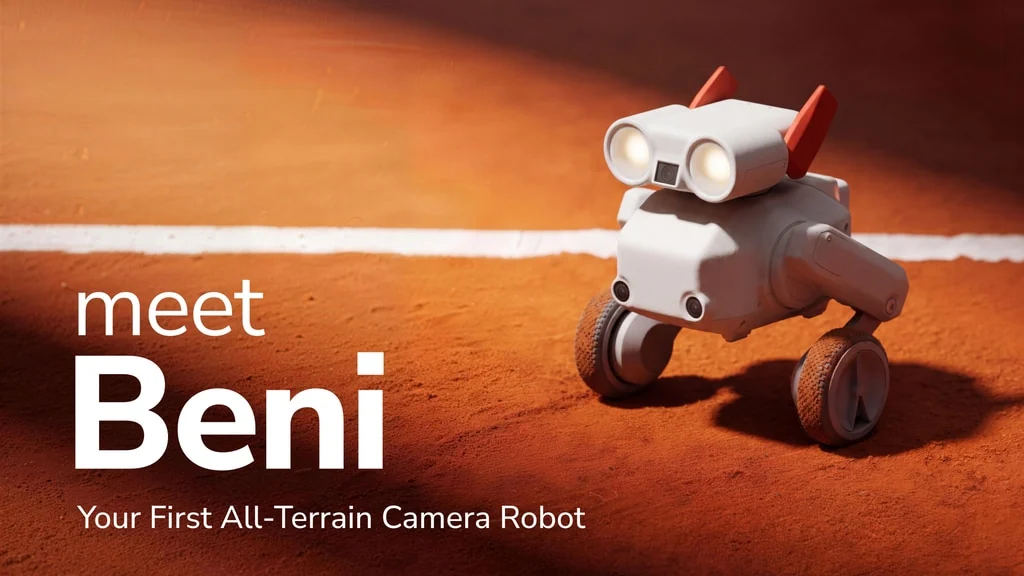
Beni is a compact camera robot that follows a person or pet while recording from close to the ground. Instead of asking a friend to run behind you with a phone, leaving a camera on a tripod, or sending a drone overhead, it puts the camera on wheeled legs that can steer, jump, and right the robot after a fall.
I think that moving viewpoint is the real reason to consider Beni on Kickstarter. Its appeal is not simply that it records 4K video. Beni is built for solo action creators, families, and pet owners who want the camera to travel with the subject. The fit becomes less convincing if you mainly shoot static scenes, need proven weather sealing, or already have a skilled camera operator.
Disclosure: This article contains an affiliate link. We may earn a commission at no extra cost to you.
Beni in One Minute: A Camera Operator on Wheels
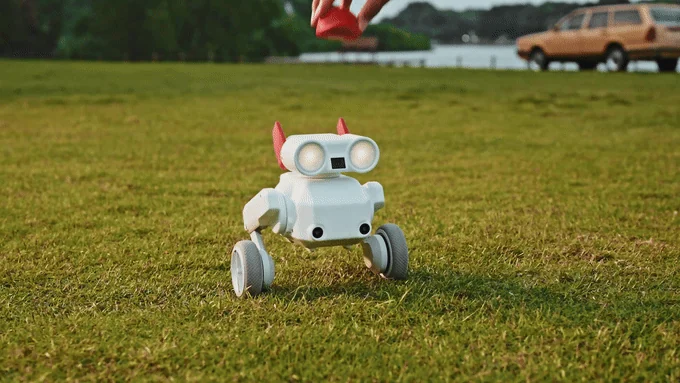
Beni measures 21.5 × 18 × 18 cm (8.5 × 7.1 × 7.1 inches) and weighs 1.75 kg (3.86 lb). Mondo Robotics says it can automatically lock on to a selected subject, move at up to about 17.9 mph (29 km/h), record stabilised footage, and avoid or jump over some obstacles. A motion tracker and mobile app provide direct control when an automatic path is not the shot you want.
That combination makes Beni different from a normal action camera. An action camera records whatever its mount points towards. Beni can change its own position. It can trail a skateboarder, move beside a runner, circle a subject, or be driven deliberately for a low push-in or reveal.
It is also different from a drone. A drone excels at elevated views and can cross terrain without touching it, but it brings noise, flight restrictions, wind, battery pressure, and a distinctly aerial perspective. Beni stays on the ground, where wheels, slopes, grass, bumps, and obstacles become part of the shot. That constraint is also its creative identity.
Why a Ground Robot Creates a Different Kind of Shot
The most persuasive Beni footage is not a specification demonstration. It is a person moving through a space while the camera remains low, close, and in motion.
Imagine a skateboarder trying to film a full line alone. A tripod can cover one fixed section, while a body-mounted camera shows the rider’s perspective rather than the complete movement. Beni is intended to roll behind or alongside the board, keeping both the rider and surroundings in view. A similar idea applies to a child riding a scooter, a runner on a path, or a dog moving through a park.
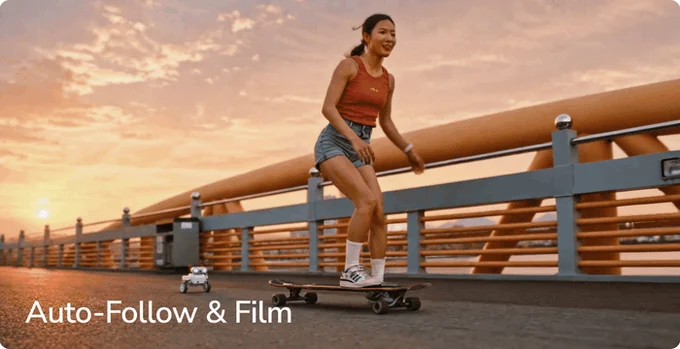
I would treat Beni as another camera position, not as a replacement for every other filming tool. A human operator can anticipate action, change composition for meaning, and respond to a chaotic scene. A drone can reveal a landscape. A tripod remains simple and dependable. Beni makes the strongest case when one person specifically needs a moving ground-level angle and no second operator is available.
How Beni Follows, Films, and Stores Footage
Beni uses onboard tracking to identify and follow a selected person or pet. Its automatic options are designed around different relationships to the subject, including following from behind, moving alongside, leading from the front, and circling. Choosing the right relationship matters because a mode that works on a clear running track may behave differently on jagged concrete or among several moving people.
Manual control expands the idea beyond follow-cam footage. The mobile app provides a live view and driving controls, while the motion tracker is intended to help Beni stay connected to its subject. That opens the door to deliberate moves such as a slow approach, a low-angle reveal, or a remotely driven point-of-view shot.
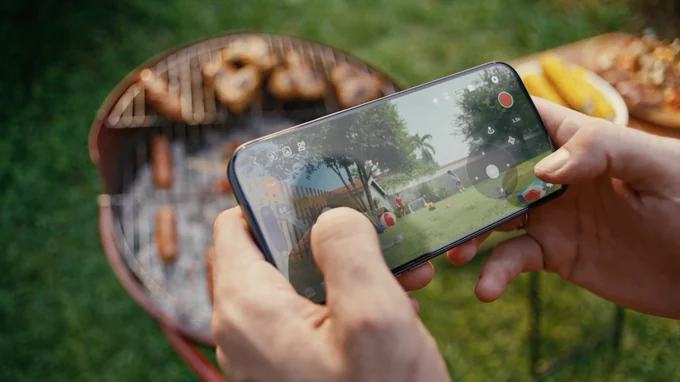
The documented recording modes are 4K at 30 frames per second, 3K at 60 fps, and 1080p at 100 fps. In practical terms, 4K prioritises resolution, while the faster modes offer more flexibility for fluid motion or slow-motion playback. Footage can be stored on 32 GB of internal storage or a microSD card.
Mondo Robotics also promotes automatic highlight editing. Its privacy explanation draws an important boundary: the company says core following, filming, and driving are processed on the robot, with footage stored locally by default. The optional AI editing function is the part that may go online, and the company says it does so with permission. That is a useful design choice, although it remains a company claim rather than the result of an independent privacy audit.
Battery life is listed as up to 1.5 hours per removable battery. I would read that as an operating target, not a universal result. Terrain, speed, automatic tracking, manual driving, and repeated jumping can all change the load. The swappable design matters more than treating one runtime figure as guaranteed.
What “All-Terrain” Means in Practice
The phrase “all-terrain” needs a sensible boundary. Beni’s wheeled legs and articulated body are meant to do more than cross a smooth floor. Mondo Robotics says the robot can reach about 17.9 mph, jump obstacles up to 10 inches high, steer around objects, and recover after being knocked over.
The self-righting behaviour is especially relevant for a camera that travels close to feet, boards, pets, and uneven ground. One beta demonstration showed the robot hitting a bump, falling, getting back up, and continuing to track. That does not prove long-term durability, but it shows why recovery is part of the design rather than a decorative trick.
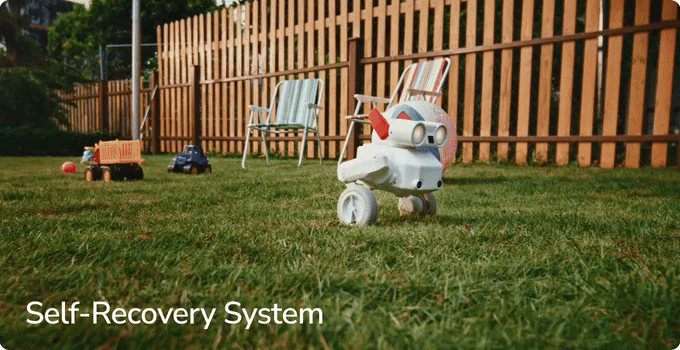
Real surfaces still matter. Beta demonstrations report capable movement over pavement, short grass, gravel, dirt paths, parks, and skate terrain. They also reveal the limits of a small ground vehicle. Tall or wet grass can reduce traction. Jagged ground can make some sideways tracking footage shakier. Dense obstacles can confuse avoidance behaviour, and rapid transitions between sunlight and shadow have affected tracking.
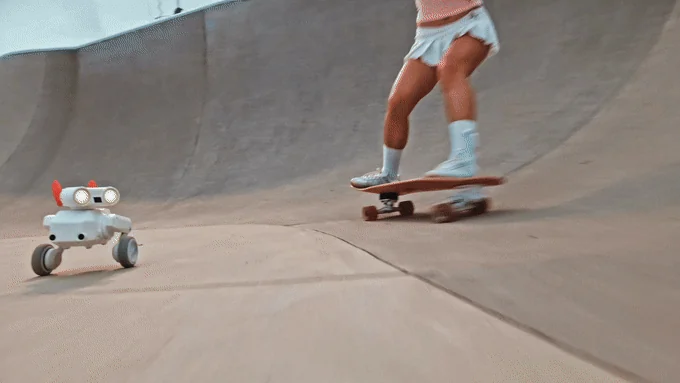
Weather is another boundary. Beni is presented for indoor and outdoor use, but the company says it should not be submerged or operated in heavy rain. I would therefore interpret “all-terrain” as mobility across a range of dry, passable surfaces, not as an all-weather or waterproof rating.
What the Beta Demonstrations Suggest
Beni looks most convincing when the route is readable and the desired camera relationship is clear. Rear-follow footage can keep a cyclist or skateboarder centred while preserving the surroundings. A low moving camera can make a family walk or a child’s outdoor play feel more active than a fixed wide shot. Self-recovery also makes sense in these informal environments, where a small collision should not end the take.
The more complex demonstrations are just as useful because they show that autonomy does not remove the need for decisions. A skater found that parallel tracking was less stable on rough ground but worked better on a smoother park surface. Adjusting turning speed helped with a difficult manoeuvre. Another demonstration reported tracking problems when people moved repeatedly between bright sun and shadow.
Those are not reasons to dismiss Beni. They are clues about how to use it well. A camera robot still has to interpret a changing scene while driving through it. I would expect better results from choosing a suitable mode, leaving enough room around the robot, and matching speed to the surface than from pressing follow and assuming every path will work.
It is also important that the demonstrated units and software were described as beta or pre-production versions. Presenters noted frequent app and tracking updates. That makes the videos promising evidence of the concept, but not a guarantee that every interface, feature, or behaviour will arrive unchanged.
Who Should Consider Backing Beni?
Best fit: solo action and outdoor creators
Beni makes the clearest sense for skateboarders, runners, cyclists, and outdoor creators who repeatedly face the same problem: the most useful angle requires another moving person. If a low follow shot is already part of the way you imagine a sequence, Beni could turn that shot from a favour into a repeatable option.
The compact body and removable battery also suit creators who want something easier to carry than a large robotic platform. What matters is whether the ground perspective fits the work. If most of your footage is talking-head video, tabletop content, or static landscape composition, Beni’s defining hardware may spend more time parked than moving.
Good fit with conditions: families and pet owners
A camera that follows from the subject’s height has an obvious appeal for family outings and pets. It can keep the person holding the phone inside the moment and create footage that feels connected to the movement rather than observed from a distance.
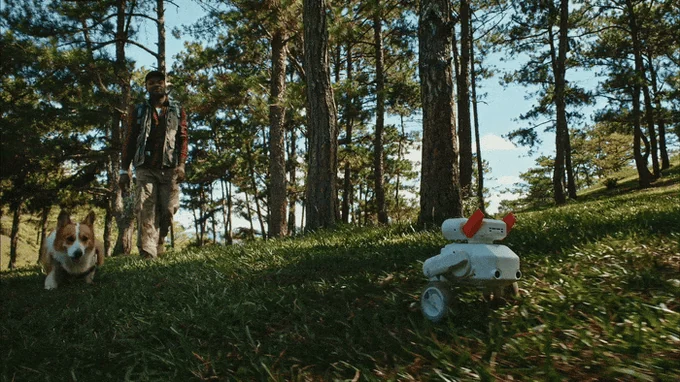
This audience should be realistic about the setting. A dry park path or short lawn is a better match than wet grass, heavy rain, a packed crowd, or a route filled with drops and roots. Pet tracking is a documented feature, but animal movement can be unpredictable, so generous space and supervision still make sense.
A weaker fit for professional crews and weather-dependent work
Beni does not need to beat an experienced camera operator to be useful. It needs to offer an angle that a solo creator could not otherwise capture. Professional crews may still appreciate it as a speciality camera, but they are less likely to depend on its autonomy.
It is also a weaker choice when the assignment demands certified weather protection, repeatable performance across uncontrolled surfaces, or independently measured image quality. Those requirements call for finished-product testing and precise operating documentation, not only campaign specifications and beta footage.
Is the Beni Kickstarter Worth Backing?
I would consider Beni if ground-level autonomous movement solves a filming problem you encounter regularly. The combination of subject tracking, multiple movement modes, 4K recording, jumping, and self-recovery gives it a purpose that is more specific than “a cute robot with a camera.”
The decision is harder if the personality is the main attraction and you do not already know what you would film. Beni asks the buyer to accept surface limits, learn how its modes behave, and take the normal uncertainty that comes with a first Kickstarter hardware campaign. Beta demonstrations make the concept tangible, but they cannot guarantee final production quality, long-term support, or delivered performance.
For a well-matched solo creator, that trade can still be compelling. The best next step is to review the current Beni campaign details, watch the available raw examples, and decide whether its distinctive camera position belongs in your kit.
Beni Camera Robot FAQ
How does Beni follow a person or pet?
Beni uses onboard subject tracking and sensors to keep a selected person or pet framed while it moves. Different tracking patterns are intended for following, leading, moving alongside, or circling the subject.
Can Beni be controlled manually?
Yes. Beni can be driven through its mobile app or motion tracker when you want to choose the path and framing directly.
What video modes does Beni support?
The documented modes are 4K at 30 fps, 3K at 60 fps, and 1080p at 100 fps. It has 32 GB of internal storage and a microSD slot.
Does Beni require an internet connection?
Mondo Robotics says Beni’s core follow, film, and play functions run on the device and store footage locally by default. Optional AI editing may use an online connection with permission.
Is Beni waterproof?
No waterproof rating is documented. The company says Beni should not be submerged or used in heavy rain.
What terrain is best for Beni?
Dry pavement, short grass, tracks, parks, and reasonably clear outdoor paths appear to be the strongest fit. Tall or wet grass, very rough ground, dense obstacles, and heavy rain can create problems.
Does Beni replace a drone or camera operator?
Not in every situation. Beni is better understood as a moving ground-level camera position. Drones provide aerial views, while an experienced operator offers more deliberate framing and anticipation.