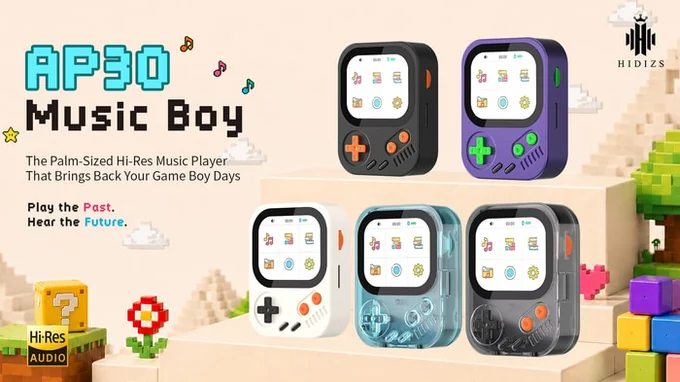
The Hidizs AP30 Music Boy is a tiny dedicated digital audio player that treats retro handheld design as more than decoration. It combines a Game Boy-inspired body, a 2-inch IPS screen, a D-pad, physical music controls, a tactile volume wheel, microSD storage, USB DAC mode, Bluetooth transmission, and both 3.5 mm and 4.4 mm headphone outputs.
What interests me is not simply that it looks cute. The AP30 makes a case for a music player that stays small, offline, and immediately touchable, while still offering enough audio hardware to matter for IEM and portable-headphone listeners. I would look at it as a playful secondary DAP or phone companion, not as a fully mature flagship replacement.
Disclosure: This article contains an affiliate link. We may earn a commission at no extra cost to you.
Why the Console Shape Matters
The obvious hook is the AP30’s pocket-console look, but the better question is whether the shape improves the way the device is used. Here, the answer is more interesting than a simple nostalgia yes. The front layout gives you a D-pad, A and B-style buttons, and two lower buttons, while the side includes a physical ALPS-style volume wheel. That makes the product feel closer to a tiny object you operate by touch than a miniature phone asking for swipes and taps.
That matters because dedicated music players are often bought to get away from the phone. A touchscreen DAP can still pull you into the same habits: unlock, look down, tap around, manage notifications if the device is Android-based. The AP30’s charm is that it seems built around quick, simple actions: skip, pause, navigate, adjust volume, and put it away.
The 2-inch IPS screen is small, with a listed 296 x 240 resolution, but that fits the product’s job. I do not think this device needs a large panel to justify itself. Its strongest value is glanceable browsing and tactile control in a body that is small enough to live with your keys, strap, bag, or phone.
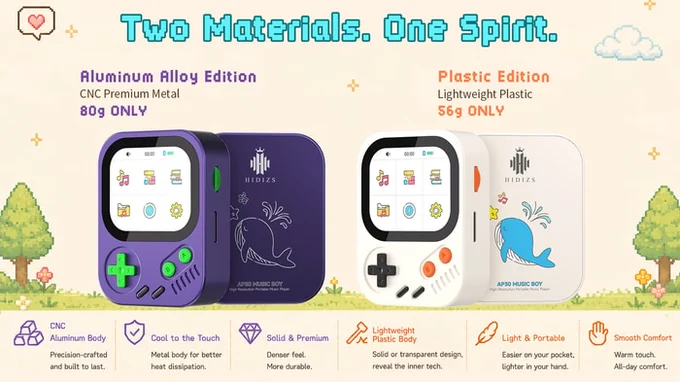
Hidizs also splits the shell into plastic and aluminum versions. The plastic editions are lighter, while the aluminum versions aim for a denser, more premium feel. Soundphile Review describes the plastic version at 56 g and the aluminum version at 80 g, which is a meaningful difference on a wearable device. I would choose plastic if the AP30 is going to hang from a strap or travel in a pocket all day, and aluminum if the object feel matters more than minimum weight.
The Audio Side Is More Than Decorative
The AP30 would be easy to dismiss if the audio section were an afterthought. It is not. The feature set centers on a Cirrus Logic CS43198 DAC, support for PCM up to 24-bit/192 kHz and DSD256, a 3.5 mm single-ended output, and a 4.4 mm balanced output. Notebookcheck and Soundphile Review both cite output ratings of 61 mW at 32 ohms from the 3.5 mm jack and 137 mW at 32 ohms from the balanced jack.
Those numbers do not make the AP30 a desktop amplifier, and I would not buy it to rescue especially difficult full-size headphones. The more sensible fit is IEMs and portable headphones, where the balanced output is a real advantage in a device this small. The 4.4 mm port also gives the AP30 a clearer identity than many novelty audio gadgets: this is a playful player, but it is still speaking to listeners who own proper wired gear.
Third-party impressions are broadly aligned on that point, though they should be read with the usual caution. One Reddit reviewer called out clean, neutral sound, low noise with sensitive IEMs, tactile controls, and useful USB DAC functionality. A YouTube reviewer described the device as more capable than its size suggests. Those are individual observations, not lab verification, but they do support the idea that the AP30 is not just a toy-shaped MP3 player.
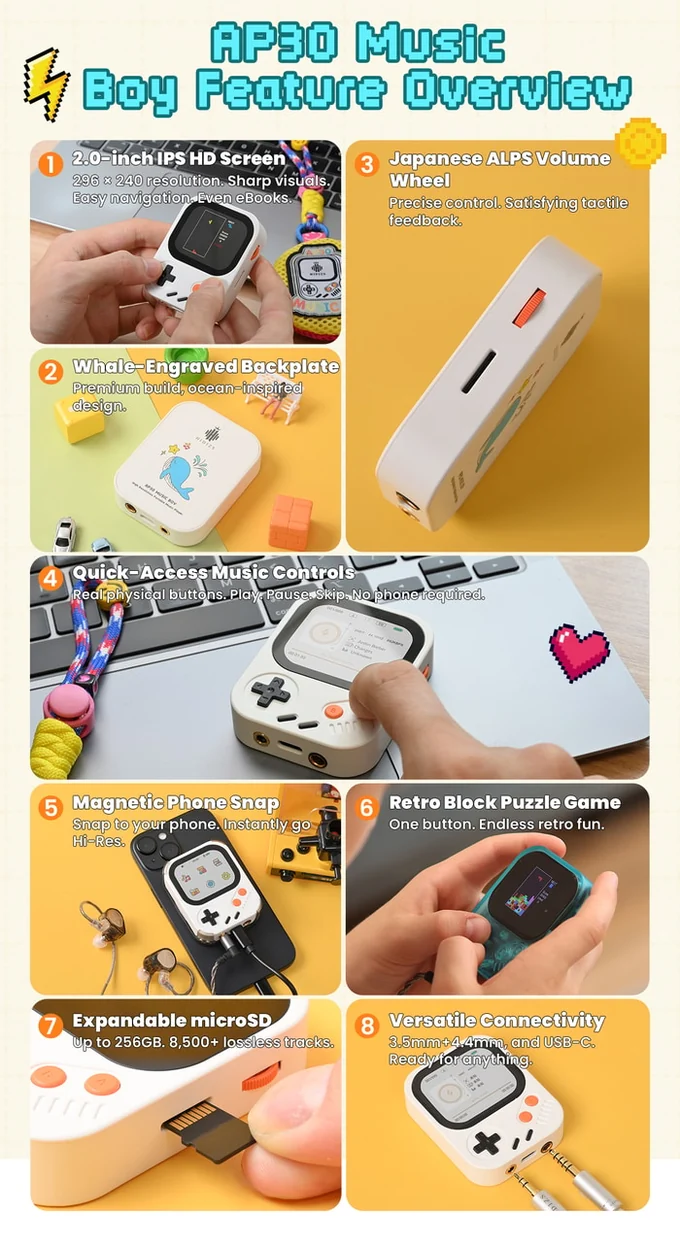
The other audio controls are worth noting because they match the small-player concept. Hidizs lists EQ presets, a custom EQ, digital filters, gain options, and HidizsOS. I would not overstate the software until retail firmware settles, but the hardware-and-controls package gives the AP30 enough substance for someone who wants a tiny DAP with real knobs, buttons, and jacks.
Offline Music Without Making Your Phone the Center
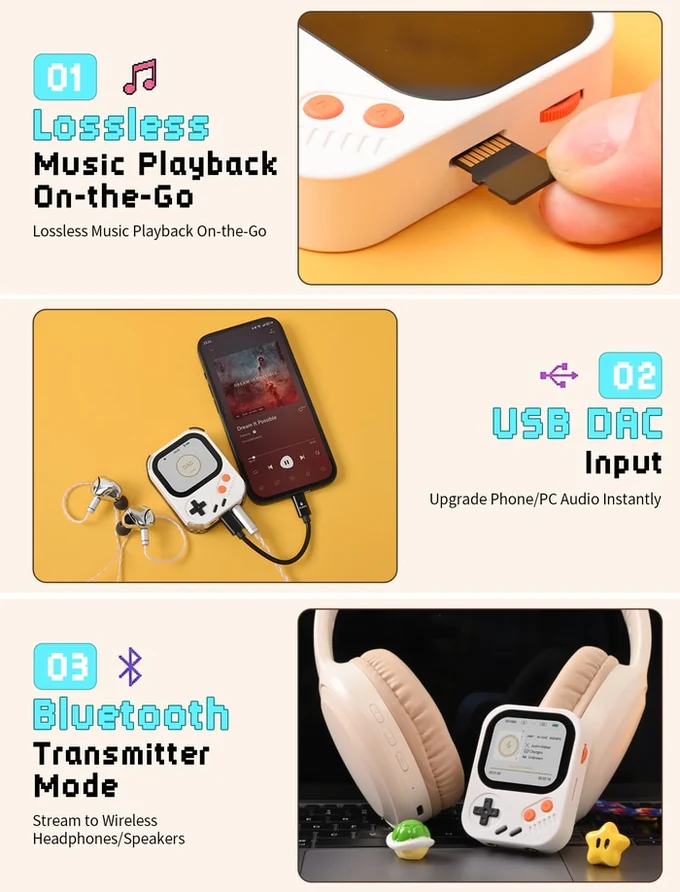
The AP30 supports microSD cards up to 256 GB according to Hidizs, and that official limit is the right number to rely on. Soundphile Review reported that a larger card could be read in their unit, but I would treat that as a useful anecdote rather than a promise. For a buying decision, the safer expectation is a 256 GB offline library.
That offline angle is one of the product’s strongest reasons to exist. A small music player is appealing when you want music without your main phone being the library, DAC, notification hub, and distraction engine at the same time. The AP30’s pitch works best for someone who has a local FLAC or WAV collection, a pair of IEMs, and a real preference for pressing buttons instead of waking a phone screen.
The AP30 can also work as a USB DAC for a phone, tablet, Mac, or PC. One video source notes a small usability quirk: after connecting to a phone, the user had to select USB audio decoding quickly, and then the host device controlled volume. That kind of detail is useful because it keeps expectations grounded. USB DAC mode sounds genuinely handy, but it may not be as friction-free as a dedicated dongle.
Bluetooth 5.3 is present too, but the exact role matters. Soundphile Review says the AP30 supports Bluetooth transmission only, with SBC rather than higher-quality codecs such as LDAC. In plain English, that means the AP30 may send audio to wireless headphones or speakers, but it should not be bought as a high-end Bluetooth receiver.
Wearable Carry Is the Product’s Most Unusual Trick
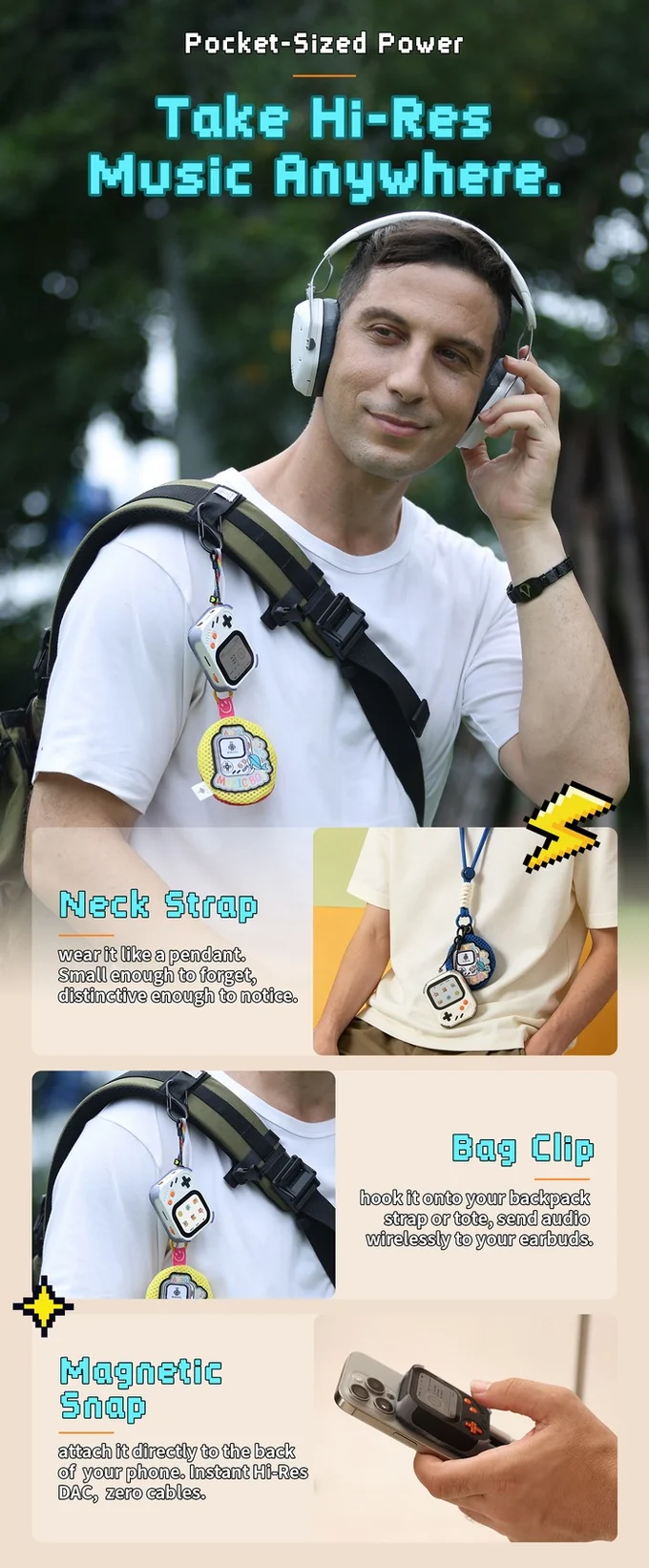
Hidizs calls the AP30 wearable, and this is where the design gets more specific. The campaign and official product page describe a magnetic phone snap, a neck strap, and a bag clip. A video reviewer also called the magnetic snap case clever, describing it as a way to keep the device attached to a phone instead of bouncing around loose in a pocket.
I like that idea most for three situations. First, a commuter using wired IEMs can keep music local and controls physical while the phone stays less involved. Second, someone at a desk can use AP30 as a tiny USB DAC without dedicating a larger DAP to the job. Third, a listener who wants wireless earbuds but offline files can clip the player to a bag and use Bluetooth transmission.
There is a little tension here. The more wearable a player is, the more important screen-off control behavior becomes. Early Reddit feedback specifically complained that physical controls and the volume wheel did not work when the screen was off. That is the kind of issue that matters more on a pocketable, clipped, strap-worn device than it would on a tabletop DAC. If Hidizs improves that behavior, the AP30’s design logic becomes much stronger.
The Fun Extras Should Stay in Their Lane
The AP30 includes a built-in block puzzle game, and that is exactly the level of seriousness I would give it. It is charming. It fits the visual language. It gives the device a small personality reward when you pick it up.
It is not a reason to expect handheld-console emulation. Notebookcheck specifically notes the missed opportunity of a Game Boy emulator, and Reddit comments also circle around that expectation. The product evidence supports a simple falling-block game, not a retro gaming device. That distinction is important because the AP30’s real reason to exist is still music.
There is also an e-book or text-reading angle in the official material and video discussion. On a 2-inch screen, I would treat that as a novelty or utility extra for simple text, not as a comfortable reading device. Again, the AP30 is more convincing when its extras add personality without pretending to replace dedicated tools.
The Main Fit Condition Is Software Maturity
The AP30’s biggest open question is not the shape or the basic hardware. It is software. A Reddit reviewer praised the hardware and sound but listed several software limitations, including no gapless playback, no M3U playlist support, screen-off control issues, limited interface theming, and rough battery presentation. Soundphile Review also described the firmware as immature in its pre-production context and questioned the battery choice relative to unused space inside the chassis.
That does not make the AP30 uninteresting. It does narrow who should consider it. If you listen to albums where gapless playback is essential, if you depend on carefully maintained playlists, or if you expect blind pocket control to work perfectly, I would wait for clearer firmware confirmation before treating this as your main player.
If your use is simpler, the calculation changes. A local music library, IEMs, tactile controls, a small body, and a balanced output can be enough. The AP30 is at its best when the buyer values charm and portability alongside audio capability, and is comfortable with the possibility that some behavior may need firmware polish.
Who Should Consider the Hidizs AP30 Music Boy
The strongest match is a listener who misses single-purpose music hardware. If you want every function on a phone, the AP30 may feel redundant. If you want a tiny object that plays local files, drives IEMs, gives you real controls, and looks like it belongs on a keychain from a more playful electronics era, it starts to make sense.
I would consider the AP30 most seriously for:
- IEM users who want a compact offline player with both 3.5 mm and 4.4 mm outputs.
- Retro-design fans who want the design to affect controls, carry, and daily handling.
- Phone listeners who want a pocketable USB DAC companion instead of another dongle.
- Existing DAP owners who want a fun secondary player rather than a flagship replacement.
I would be more cautious if your music library depends on gapless playback or advanced playlist handling. The AP30’s physical controls and wearable pitch also make screen-off behavior especially important, so that is a detail worth checking in current firmware discussion before backing.
For well-matched listeners, though, the appeal is easy to understand. The AP30 Music Boy has a rare combination of small size, physical interaction, playful identity, and audiophile-friendly ports. It feels like a tiny product with an actual point of view.
FAQ
What audio formats does the Hidizs AP30 Music Boy support?
Hidizs lists support for PCM up to 24-bit/192 kHz and DSD256, with lossless formats such as FLAC and WAV also appearing in the official material.
Does the AP30 Music Boy have balanced output?
Yes. The AP30 includes a 3.5 mm single-ended output and a 4.4 mm balanced output. Third-party coverage cites 61 mW at 32 ohms from the single-ended jack and 137 mW at 32 ohms from the balanced jack.
Can the AP30 Music Boy work as a USB DAC?
Yes, USB DAC mode is part of the feature set. One video source notes that phone use may require selecting USB audio decoding after connection, so I would treat it as useful but not completely automatic.
Is Bluetooth receiving supported?
Soundphile Review reports Bluetooth 5.3 transmission only, not receiver mode, and says SBC is the supported codec. That makes it better suited to sending music to wireless headphones or speakers than acting as a Bluetooth input device.
Does the AP30 Music Boy play retro console games?
The supported evidence points to a built-in block puzzle game. It should not be treated as a Game Boy emulator or a retro gaming handheld.
Who is the AP30 Music Boy best for?
It is best for listeners who want a tiny offline DAP with physical controls, IEM-friendly outputs, a playful design, and phone-companion flexibility. It is less ideal for people who need mature gapless playback, advanced playlist support, or a full-size DAP replacement.
If that sounds like your kind of listening device, you can check the live campaign and current options here: see the Hidizs AP30 Music Boy campaign.