Affiliate disclosure: If you back Pongbot Aura through links in this article, Geeky Review may earn a commission at no additional cost to you.
Pongbot Aura at a Glance
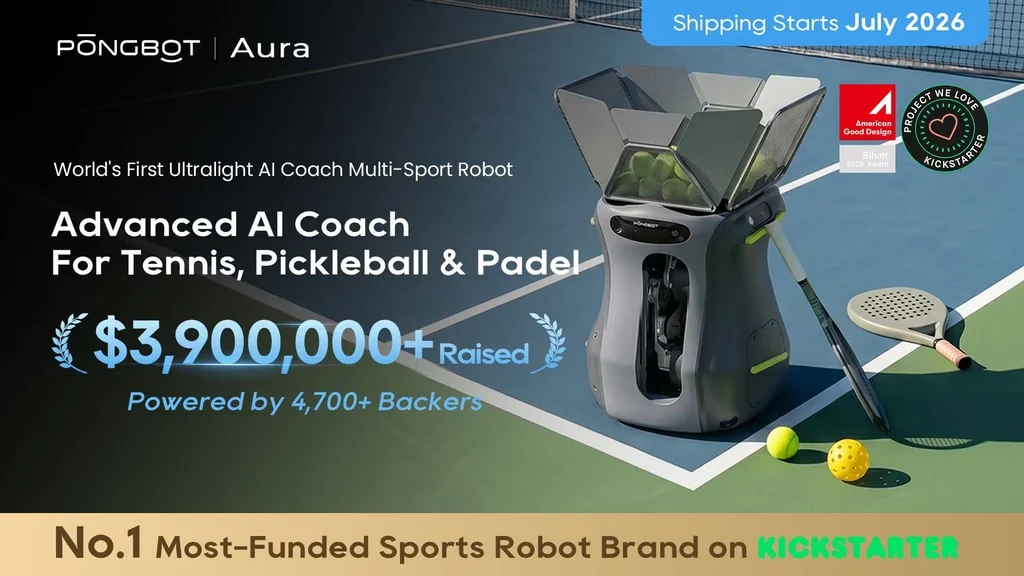
Pongbot Aura is a portable ball-training robot built around an unusually practical idea: one machine that can feed tennis, pickleball, and padel balls. Instead of treating each sport as a software preset, Aura uses an adjustable wheel track and an automatically calibrated feed path intended to accommodate balls with different diameters, materials, and aerodynamics.
That mechanical flexibility is the strongest reason to consider Aura. Its programmable drills can then turn the adaptable launcher into a more useful solo practice partner. Pongbot also layers on voice control, camera-based form analysis, match-pattern recreation, and recovery-aware feeding, but those more ambitious functions depend on the model or accessory configuration and have not been independently validated. My view is straightforward: Aura is most compelling as a lightweight, multi-sport training machine first and an AI coach second.
The Hardware Trick Is Physical Adaptation, Not Just an App Mode
Tennis balls compress as they pass through a launcher. Pickleballs are lighter, harder plastic shells with holes. Padel balls resemble tennis balls but operate in a different court environment. Asking one fixed feed mechanism to handle all three well is not simply a matter of selecting a new label in an app.
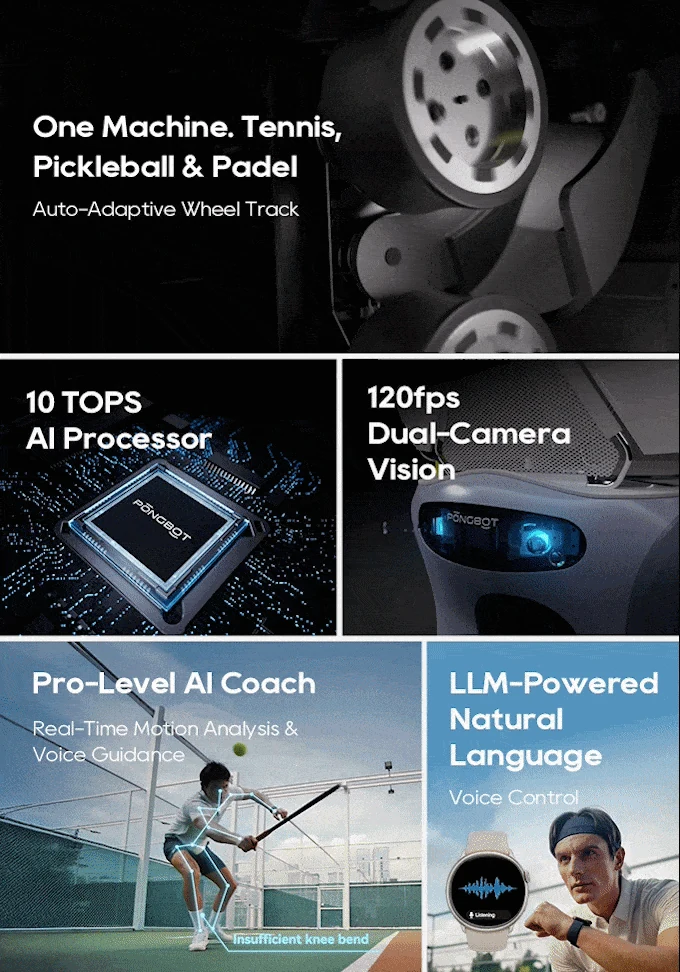
Aura addresses that problem by changing the spacing of its internal wheels. Pongbot describes a 40–80 mm compatibility range, while product demonstrations show the machine feeding standard and low-compression tennis balls as well as indoor and outdoor pickleballs. A first-impressions video also shows the distance between the wheels changing for the selected ball type. Those demonstrations establish that the idea works at a prototype level; they do not yet prove long-term durability or equal accuracy with every supported ball.
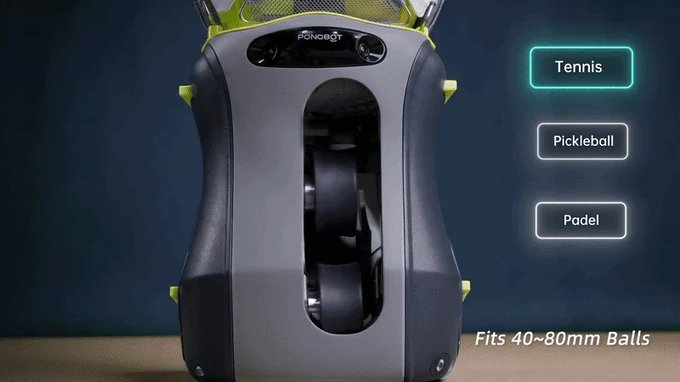
Portability strengthens the concept. Aura is reported to weigh about 7 kg, or 15 lb, and measure 457 × 376 × 430 mm. That makes it easier to move between courts than many full-size machines. Pongbot also claims a swappable battery lasting up to five hours and capacity for approximately 100 pickleballs or 120 tennis or padel balls. Capacity varies logically with ball size, and these runtime and capacity figures should be treated as manufacturer specifications until tested on production hardware.
Custom Rallies Are the Most Concrete Training Upgrade
A versatile feed mechanism matters only if the drills make good use of it. Here, Aura’s custom programming looks more substantial than a simple left-right oscillation setting.
In one demonstration, the presenter builds a complete sequence: four baseline balls split between forehand and backhand sides, an approach shot, four volleys, and an overhead. The intervals are longer during the baseline phase to allow recovery across the court, then tighter after the approach to reproduce the pressure of a quick exchange at the net. That change in timing turns isolated repetitions into a recognisable point pattern.
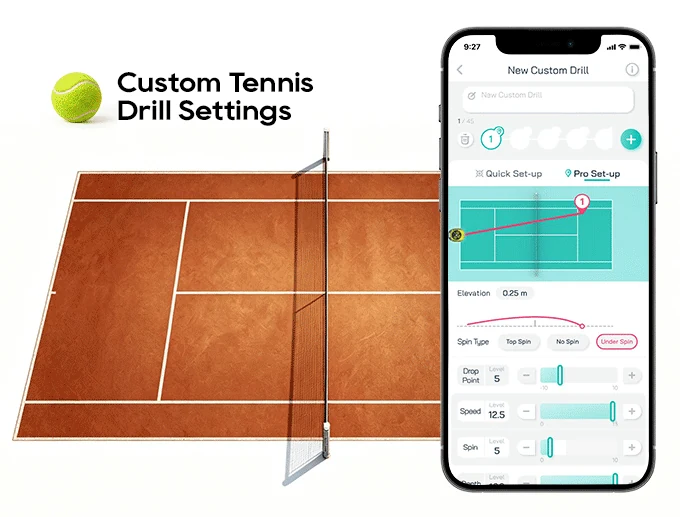
This is the part of Aura that feels easiest to evaluate without buying into broad AI promises. A coach could construct movement patterns for a student, while a solo player could rehearse transitions that ordinary random feeds rarely reproduce. The app concept provides control over placement, timing, speed, spin, elevation, and sequence. The interface may change before release, but the training logic is already clear.
What the AI and Spotter Layer Is Supposed to Add
Pongbot’s larger vision connects the ball machine to cameras and software. The proposed system watches a swing, divides the motion into phases, diagnoses issues, updates a training plan, and provides voice feedback before or during subsequent feeds. It is also promoted as being able to interpret natural-language requests, recreate patterns from uploaded match footage, wait until a player has recovered before launching the next ball, keep score, create highlights, and generate reports.
Those ideas could reduce court-side menu work and make solo sessions more responsive. Saying “give me a fast cross-court ball with heavy topspin” is more convenient than editing multiple controls between drills. A recovery trigger could also be safer and more realistic than firing the next ball on an inflexible timer.
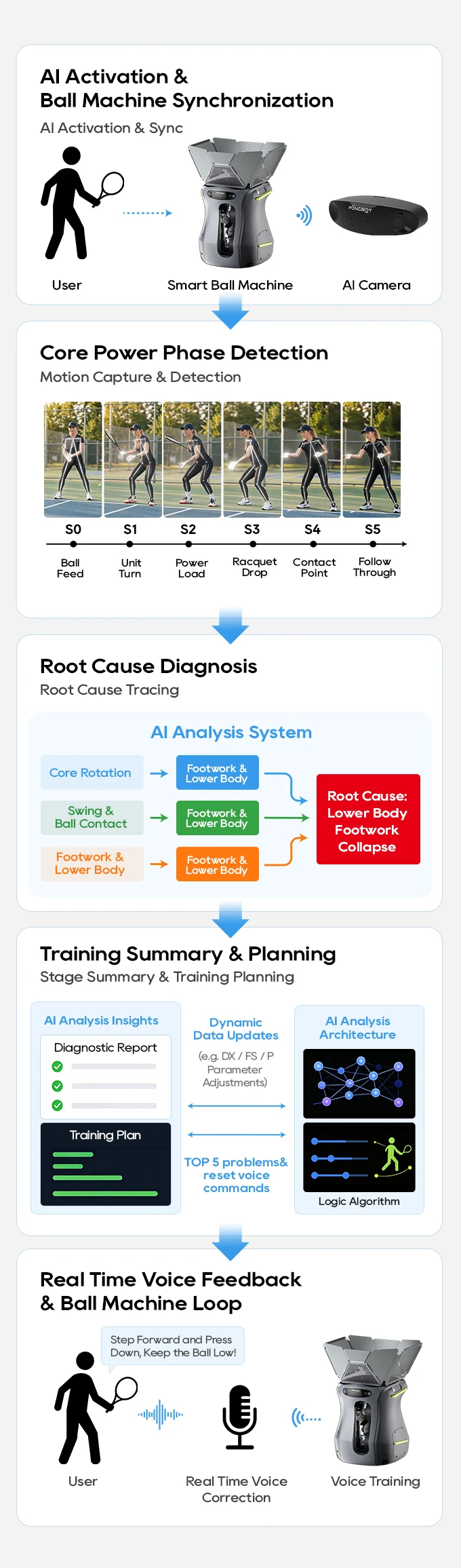
However, these are outcome claims, not independently measured capabilities. Camera tracking can be affected by court layout, lighting, occlusion, clothing, and player position. Natural-language control must reliably translate a request into safe machine settings. Form feedback is useful only if the diagnosis is consistent and technically sound. Until reviewers can test production hardware and software, these features are best understood as Pongbot’s intended system.
Aura and Aura S Need a Clear Model Distinction
The campaign materials distinguish the base Aura from Aura S. Both are presented as multi-sport launchers with drill programming and voice control. Aura S adds the Spotter, a dual-camera module that Pongbot associates with full-court tracking, form analysis, recovery triggering, video-based drill recreation, and movement heat maps.
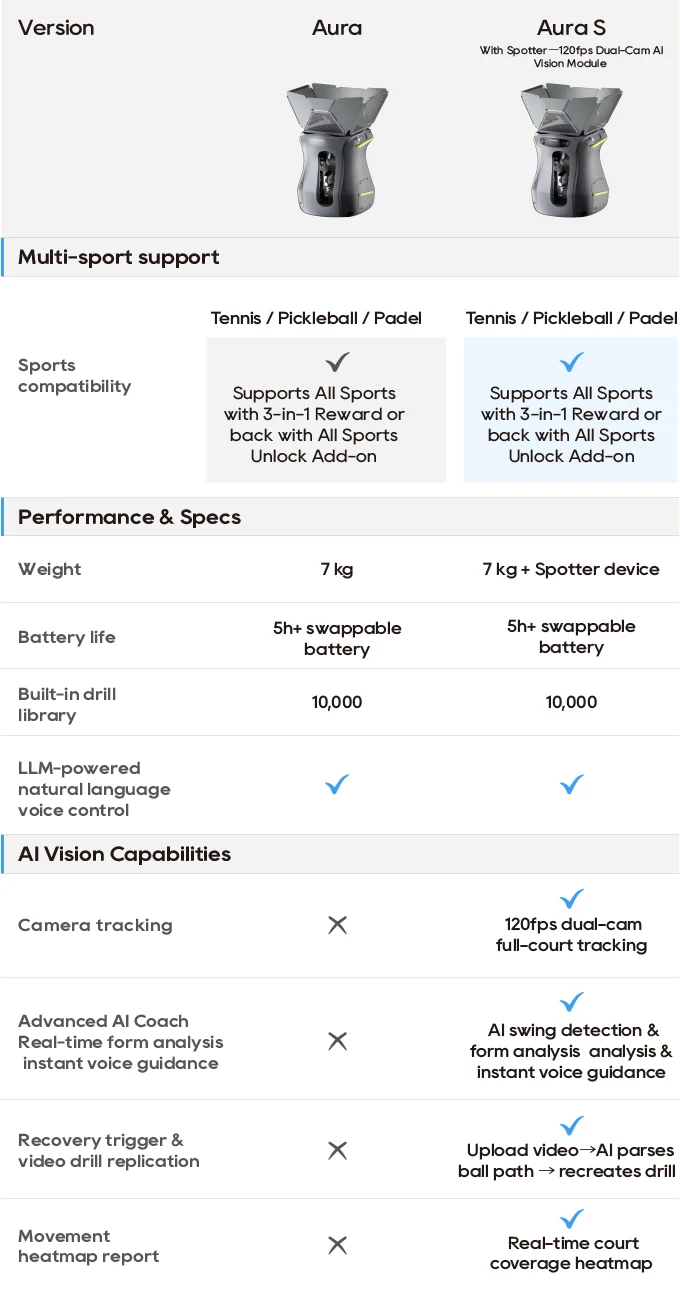
Spotter is also described as detachable, allowing it to be placed near the net for scoring, streaming, and highlight functions. Buyers should therefore check exactly which model and modules contain the features they want. It would be a mistake to assume that every mention of “AI coaching” applies to the base configuration without the relevant camera hardware.
Three Sports, Three Useful Practice Scenarios
Aura’s value is easier to understand through court situations than through a long specification table.
Tennis Point Construction
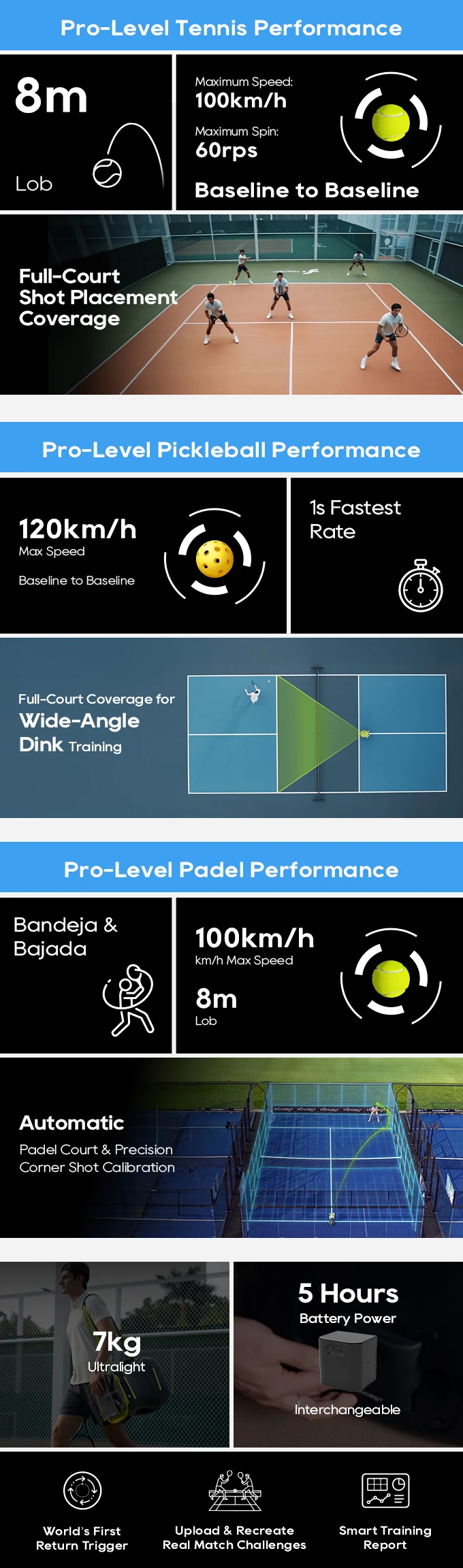
Tennis players can combine deep groundstrokes, an approach ball, volleys, and an overhead in one programmed sequence. Adjusting the interval between phases forces the player to move forward and change technique instead of repeating the same stroke from one position. This is a practical fit for point construction, transition work, and high-volume repetition.
Pickleball Kitchen Repetition
For pickleball, the clearest use is repeated work on dinks, drops, drives, placement, and rhythm. The lighter plastic ball is precisely why the adaptive feed path matters. Pongbot also promotes responsive drills, but the dependable baseline value is the ability to program consistent feeds for focused kitchen and transition-zone practice.
Padel Wall and Transition Patterns
Padel adds walls and a more complex set of trajectories. A padel demonstration presents Aura working on baseline defence, cross-court attacks, wall-rebound recovery, lobs, and movement toward the net. Pongbot says the system can recognise and calibrate for a padel court. That calibration still needs independent testing, but custom sequences could be useful even before the advanced vision layer is considered.
Who Pongbot Aura Fits Best
Aura makes the most sense for players who regularly practise more than one of its three core sports. A multi-sport household, coach, academy, or club can potentially replace several sport-specific launchers with one easier-to-carry platform. It also suits solo players who care about programmed point patterns and transitions more than having the machine move around the court.
The fit is less obvious for a tennis-only player whose priority is autonomous positioning. Aura is stationary in its standard form. Pongbot has shown a Mobile Base concept intended to move the machine for short-ball practice, but that is a separate part of the proposed ecosystem. The machine also does not retrieve balls that have accumulated on the court.
There is limited owner context from earlier Pongbot products. In a Reddit discussion, one Pace S Pro owner praised the machine overall while describing parts of the app and custom-drill setup as clunky. That is one person’s experience with a different model, not evidence that Aura will behave the same way. It does, however, underline why software usability matters for a product whose best training features depend on programming sequences.
Fit Conditions to Understand Before Backing
The adaptive wheel system has been shown handling different balls, but there is no independent long-term test of wear, calibration consistency, feed accuracy, battery life, or reliability across sports. The camera, voice, analysis, and match-recreation functions are even less established outside Pongbot’s own demonstrations and campaign materials.
Crowdfunding also carries ordinary execution risk. Specifications can change, software can arrive with missing features, and fulfilment can take longer than planned. Buyers should evaluate Aura on the functions that matter to them now, distinguish base-machine features from Aura S and optional modules, and avoid treating proposed upgrades as guaranteed outcomes.
Should You Consider Backing Pongbot Aura?
I think Aura is worth considering if you genuinely train across tennis, pickleball, or padel and want detailed, programmable drills in one portable machine. Its physical adaptation to different balls is a more persuasive distinction than the generic “AI” label, and the custom-rally demonstration shows a credible path from repetitive feeding to structured solo practice.
The decision becomes more conditional if camera coaching is your main reason to buy. Aura S and Spotter may eventually make the system much more responsive, but analysis accuracy, voice reliability, and match-pattern recreation need production-level testing. A buyer who is comfortable with that uncertainty can view the Pongbot Aura campaign. A buyer who needs independently proven coaching or autonomous movement should judge the machine primarily by its demonstrated feed and drill capabilities.
Frequently Asked Questions
Can Pongbot Aura Feed Tennis, Pickleball, and Padel Balls?
Yes. Pongbot presents Aura as a three-sport machine with an adaptive wheel track for balls from 40 to 80 mm. Videos show it feeding multiple tennis-ball types and indoor and outdoor pickleballs. Long-term performance across every supported ball has not yet been independently established.
Is Pongbot Aura Mobile or Stationary?
Aura is stationary during normal feeding. The machine is portable between courts, but it does not autonomously reposition itself in the base configuration. Pongbot has presented a separate Mobile Base concept for movement.
What Is the Difference Between Aura and Aura S?
Both are presented as multi-sport ball machines. According to Pongbot’s comparison materials, Aura S includes the Spotter dual-camera hardware associated with tracking, advanced form analysis, recovery triggers, video drill recreation, and heat maps.
What Does the Spotter Module Do?
Pongbot describes Spotter as a detachable camera system for full-court tracking, form analysis, scoring, streaming, automatic highlights, and training reports. These capabilities remain manufacturer claims pending independent testing.
Can Users Create Their Own Shot Sequences?
Yes. Aura’s custom-drill interface is designed to combine shot placement, timing, speed, spin, and elevation. A demonstration shows a sequence progressing from baseline shots to an approach, volleys, and an overhead.
Does Pongbot Aura Collect Returned Balls?
No. Available product coverage says Aura feeds balls but does not collect the balls left around the court.
Who Is Pongbot Aura Best Suited To?
The strongest fit is a multi-sport player, coach, household, or club that wants one portable launcher for structured tennis, pickleball, and padel drills. Tennis-only players who prioritise autonomous machine movement may prefer a more specialised alternative.